


On this page
Every espresso shot comes down to two numbers: how much ground coffee goes in, and how much liquid comes out. The relationship between them is the brew ratio, and it is the single most useful thing to control if you want your shots to taste the same twice.
What the Ratio Means
A ratio of 1:2 means the shot weighs twice the dose. Put 18 grams of ground coffee in the basket and stop the shot at 36 grams in the cup. That is a standard double shot and the starting point for nearly every café.
We pull ours a little longer, to 36 to 40 grams, because we drink lattes and a slightly longer shot carries through the milk better. A straight espresso drinker might stop at 34.
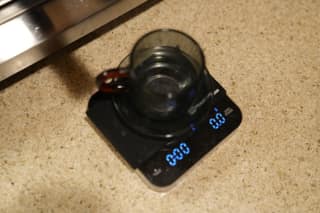
The ratio is measured by weight, not volume. Crema is mostly gas, and the amount changes with the roast, the age of the beans, and the day. A shot glass with a line on it will lie to you. A scale will not.
Step 1: Weigh the Dose
Put a cup on the scale, tare it, and weigh out your beans. We use 18 grams for the 58 mm basket on our Breville Oracle. Most double baskets are designed for 16 to 20 grams; check yours.
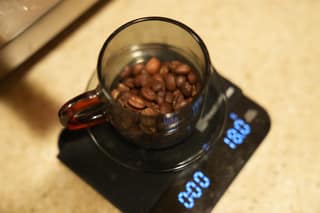
Weighing whole beans before grinding is easier than weighing grounds in the portafilter and is accurate enough. If you single-dose, which we do, the hopper gets exactly these beans and nothing more. Our single dosing guide covers why.
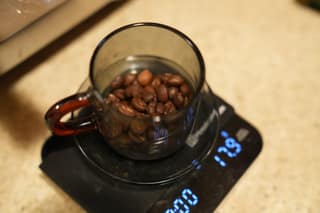
Step 2: Tare the Cup Under the Group Head
After the portafilter is locked in, set the scale on the drip tray, put your cup on it, and tare it to zero. The scale needs to fit under the group head with the cup on it; a small, flat one works best.
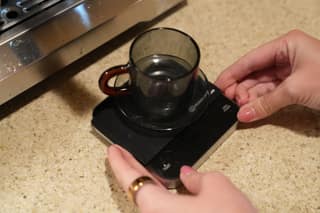
Step 3: Stop the Shot at Your Target Weight
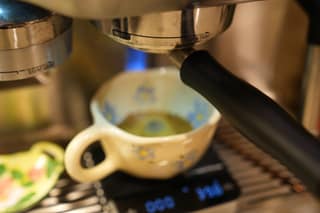
Start the shot and watch the scale. When it reads your target, stop the pump. On a machine with programmable volumes you can set it to stop automatically, but the scale still tells you whether the program is doing what you think.
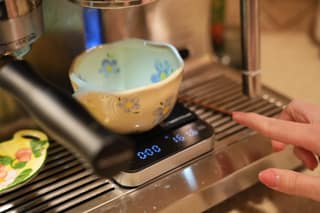
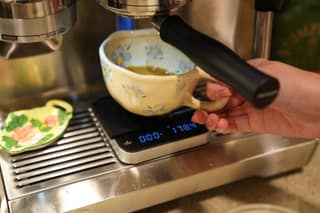
The shot will keep dripping for a second after the pump stops, so stop a gram or two early. Ours lands at 39.8 when we stop at 38.
Step 4: Note the Time
The time it took to reach the target weight is your diagnostic. A 1:2 shot in 25 to 30 seconds is the usual target. If the same dose reached the same weight in 15 seconds, the grind is too coarse. If it took 45 seconds, too fine.
Keep the ratio fixed and change the grind until the time lands where you want it. That is the whole process of dialing in, and it only works if the ratio is held constant.
How the Ratio Changes the Taste
Once the grind is dialed in, you can move the ratio to tune the flavor.
| Ratio | Name | 18 g dose yields | How it tastes |
|---|---|---|---|
| 1:1 to 1:1.5 | Ristretto | 18–27 g | Thick, sweet, intense, less bitter |
| 1:2 | Normale | 36 g | Balanced, the standard shot |
| 1:2.2 | Our latte shot | 38–40 g | Slightly more extracted, carries through milk |
| 1:3 or more | Lungo | 54 g+ | Thin, more bitter, more caffeine |
Shorter shots are more concentrated and sweeter but risk tasting sour if the grind is not fine enough. Longer shots pull more out of the coffee, including bitterness. Most people land somewhere between 1:1.8 and 1:2.5.
For a milk drink we go slightly long. For a straight espresso we go slightly short. The dose never changes.
Why Not Just Fill the Basket?
Filling by eye changes the dose by a gram or two every shot. A gram is about 5 percent of an 18-gram dose, enough to move a shot from balanced to sour without any other change. When the dose wanders, you cannot tell whether a bad shot came from the grind, the beans, or the amount, so you end up adjusting the wrong thing.
Weighing takes ten seconds and removes one variable permanently. It is the cheapest upgrade in espresso. If you are starting from scratch, our how to make espresso walkthrough puts the ratio in context with the other four steps.
More Coffee Guides
Frequently asked questions
What is the standard espresso ratio?
About 1:2. For every gram of ground coffee, you get two grams of liquid espresso. An 18-gram dose pulled to 36 grams is the classic double shot. We run a little longer, to 36 to 40 grams, for lattes.
Do you measure espresso by weight or volume?
By weight. Crema adds volume that varies from bean to bean and day to day, so a shot glass line is unreliable. A gram scale under the cup gives the same answer every time.
What is a ristretto vs. a lungo?
Both are ratios. A ristretto is a short shot, around 1:1 to 1:1.5, so it is more concentrated and sweeter. A lungo is a long shot, 1:3 or more, so it is thinner and more bitter. A normal shot sits between them at about 1:2.
How long should an espresso shot take?
Roughly 25 to 30 seconds from pump start to hitting your target weight. Time is a symptom, not a target. If the shot reaches 36 grams much faster, grind finer. If it takes much longer, grind coarser.
What scale do you need for espresso?
Any scale that reads in 0.1-gram increments and fits on the drip tray under the cup. A built-in timer helps. We use a small battery-powered one that lives on the counter next to the machine.


