


On this page
Tamping compresses loose grounds into a flat, even puck so water flows through all of it at the same rate. When the puck is uneven, water takes the easy route through the thin spots, and the shot is sour, fast, and weak. That is channeling, and a bad tamp is the usual cause.
The good news is that tamping is simple once you stop thinking about pressure and start thinking about level.
Step 1: Start With a Level Dose
Tamping cannot fix an uneven dose. If the grounds are piled higher on one side, the tamper presses that side harder and the puck ends up denser there.
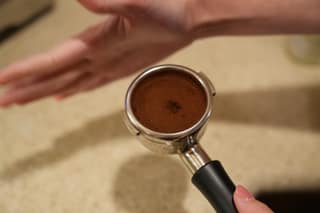
Run a finger across the top of the basket to level the grounds, or tap the side of the portafilter on the counter a couple of times to settle them. The surface should be flat and even to the edge.
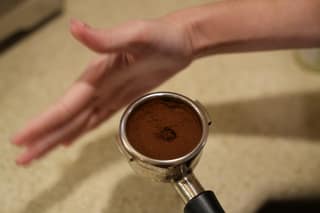
If you weigh your dose, this is also when you check it. We use 18 grams in the Oracle's 58 mm basket. Our espresso ratio guide explains why that number.
Step 2: Set the Portafilter on a Flat Surface
Put the portafilter on the counter or a tamping mat with the basket flat and the handle pointing toward you. Hold it steady with your other hand. Tamping with the portafilter in the air tilts it, and a tilted portafilter means a tilted puck.
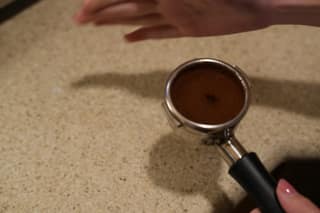
Step 3: Press Straight Down
Hold the tamper like a doorknob, with your elbow above it, and press straight down. Keep your wrist straight so the force goes through the center of the tamper.
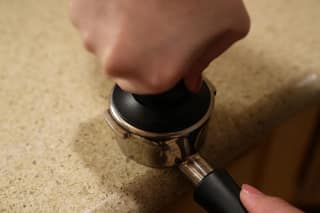
Press until the grounds stop giving. That is firm, but it is not a feat of strength. You will feel the puck go solid. Once it does, more pressure changes nothing.
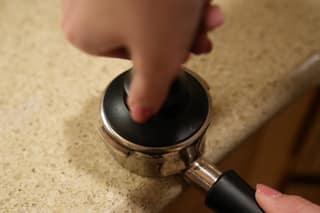
Consistency matters more than the exact number. The same press every shot gives you the same puck every shot, which means grind size is the only variable left when you dial in.
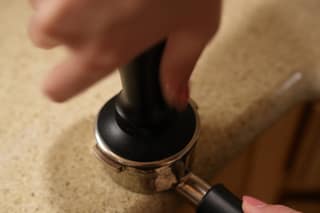
Step 4: Lift Straight Up and Check the Puck
Lift the tamper straight out. A slight twist at the end polishes the surface and helps it release cleanly, but it is optional. Do not twist while pressing; that can shear the top layer.
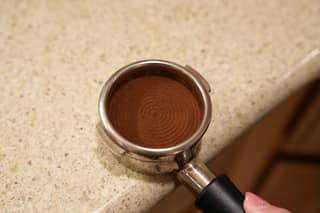
Look at the puck. It should be flat and level with the surface the same distance below the rim all the way around. The rings you see on ours are left by the tamper base and do not affect the shot.


Wipe loose grounds off the rim of the basket before locking in. Grounds on the rim keep the portafilter from sealing and can leak around the gasket.
Step 5: Lock In and Pull
Carry the portafilter level to the machine. Knocking it against the drip tray or tilting it hard can crack the puck before the shot even starts.
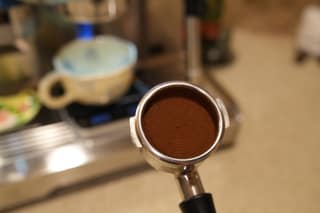

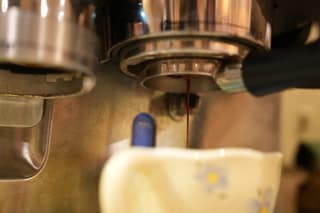
The proof is in the flow. With a bottomless portafilter, a well-tamped puck gives a single steady stream from the center of the basket. Spraying, dripping from the edges, or a stream that jumps around means the puck channeled.
Mistakes That Cause Channeling
- Tamping a mound. The high side gets compressed more than the low side. Level first.
- Tilting the tamper. One edge of the puck ends up thinner. Elbow over the tamper, wrist straight.
- Tamping in the air. The portafilter tilts in your hand. Put it on the counter.
- Tamping twice. The portafilter shifts between presses and the puck cracks. Once is enough.
- Grounds on the rim. The portafilter will not seal flat. Wipe the rim.
- Banging the portafilter. Knocking it on the drip tray to settle the puck does the opposite. Carry it gently.
About Automatic Tamping
Our Breville Oracle tamps automatically in the grinder cradle, which takes most of this off the table. We still level the dose and give it a hand tamp out of habit, and because we like the step. If you have an automatic tamper, you can skip the pressing and keep the leveling. If you have a manual machine, this routine is the whole job.
More Coffee Guides
Frequently asked questions
How hard should you tamp espresso?
Firmly, until the grounds stop compressing, and then stop. The old 30-pound rule is more pressure than you need. Once the puck is compressed, pushing harder does nothing except strain your wrist. Keeping the tamper level matters far more than the force.
What happens if you tamp too hard?
Usually nothing. Coffee compresses only so far. Tamping too hard mostly leads to inconsistent pressure from shot to shot and sore wrists. Tamping unevenly is the real problem.
Should you tamp twice?
No. One level press is enough. A second tamp can crack the puck if the portafilter shifts between presses. A light polish twist at the end is optional and does not hurt.
Why does my espresso puck have a hole or crack in it after the shot?
Water found a weak spot in the puck and channeled through it. The cause is almost always an uneven dose or a tilted tamp, not the pressure. Level the grounds before tamping and press straight down.
Does the Breville Oracle tamp automatically?
Yes. The grinder cradle doses and tamps the basket when you push the portafilter in. We still level the dose and finish with a hand tamp on ours out of habit. The automatic tamp alone works fine.


