


On this page
A pool test strip is a fast sorting tool. It can show that chlorine has moved into a different color band or that pH is no longer near its usual reading. It cannot turn a wide printed block into a precise number, and it cannot measure beyond the limits on the bottle.
Use strips for quick checks, then reach for a more precise test when the result will drive a large or difficult-to-reverse correction. That distinction matters most with sanitizer, cyanuric acid, calcium hardness, and a pool that is already cloudy or green.
Step 1: Read This Bottle Before Testing
The instructions on the current container control the test. Do not reuse the timing or dip motion remembered from another brand.
Before removing a strip, find:
- the expiration date;
- the measurements included;
- the order of the pads and chart rows;
- the required dip depth, motion, and time;
- how to hold the strip while it develops;
- the reading time for each pad; and
- the highest and lowest block for every measurement.
Some strips measure free chlorine; others show total chlorine, or include separate pads for both. A bromine scale printed beside chlorine is an alternate reading for brominated water, not another number to add to the chlorine result.
Dry your hands. Remove one strip by its plain handle without touching the reagent pads, then close the cap immediately. Humidity admitted for one test reaches every strip in the bottle.
Step 2: Choose Water That Represents the Pool
Avoid sampling next to a return jet, skimmer opening, tablet feeder, floating chlorinator, fill hose, or a spot where a chemical was just poured. Water in those areas can be more concentrated or more diluted than the rest of the pool.
Let added products circulate for the time stated on their labels before retesting. If the strip directions call for a direct dip, reach to the specified depth without touching the wall.
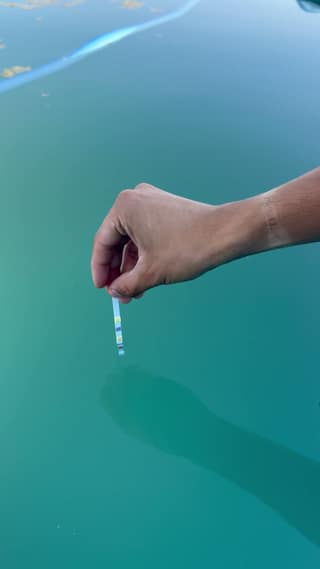
If the maker calls for a water sample in a clean cup instead, use that method. Direct dipping and cup testing are not interchangeable unless the instructions say they are.
Step 3: Dip Once, Exactly as Directed
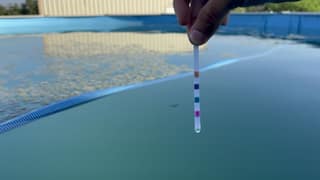
Submerge every reagent pad for the stated time. A quick in-and-out motion, a short swish, and a stationary soak expose the pads differently, so copy the label rather than a generic online demonstration.
Remove the strip once. Do not rub the pads, wipe them, or redip after the reaction has started. Leaving the strip in longer does not give the reagents a better sample; it changes the test procedure.
Step 4: Control the Water and the Clock
Many multi-parameter strips must stay level with the pads facing up. This limits water moving from one reagent pad into the next. Some products specify another position or a particular way to remove excess water.
Do not shake by habit. The HTH strips shown here instruct the user not to shake, while another product may give different handling directions.

Start a timer as directed. If the label assigns different reading times to different pads, read them in that order. Do not set the strip aside and compare it after it dries.
Step 5: Match One Pad at a Time
Use bright, indirect daylight or another neutral white light. Warm bulbs, colored patio lights, hard glare, and deep shade can shift the apparent match.
Hold the strip beside the chart without touching the wet pads to the bottle. Confirm the row label, compare one pad, then move to the next.
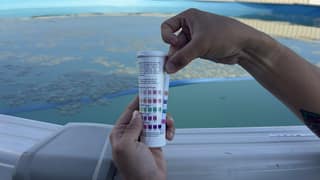
If the color sits between two blocks, record the interval or the nearest block allowed by the instructions. A chart that jumps from 3 to 5 ppm does not support a report of 4.0 ppm.
Phone cameras change exposure, white balance, and saturation. Use a photo or scanning app only when the strip maker supports that exact product and supplies the reading procedure.
Step 6: Interpret Only What the Pad Measures
The pictured strip includes several common measurements. Read the names on your bottle because a similar pad color can represent a different test on another product.
Free Chlorine, Total Chlorine, or Bromine
Free chlorine is the portion available for disinfection. Total chlorine includes free and combined chlorine. A strip with only one chlorine pad may not give the information needed to calculate combined chlorine.
CDC's home-pool guidance recommends at least 1 ppm free chlorine in a pool, or at least 2 ppm when cyanuric acid or stabilized chlorine is used. CDC gives 7.0–7.8 for pH. Product directions, local requirements, and the pool's CYA level may call for an operating target above the minimum chlorine value.
pH
pH affects swimmer comfort, equipment, and chlorine performance. If the pad is at the end of its scale, it says the sample is at or beyond that boundary; it does not show how far beyond.
Total Alkalinity
Alkalinity describes the water's resistance to pH movement. It is not another pH reading. A broad strip result can flag a problem, but the appropriate correction depends on the measured value, pool volume, and product instructions.
Cyanuric Acid
CYA slows sunlight loss of chlorine and also changes how much free chlorine is needed. Because excess CYA is not corrected by a simple neutralizing dose, confirm a broad strip reading before adding stabilizer.
Calcium or Total Hardness
Hardness affects water balance, surfaces, and equipment. Strip intervals can be too wide for a large adjustment, especially when the reading sits between blocks.
Step 7: Decide Whether the Result Is Strong Enough to Act On
Write down the ranges and compare them with prior results. A record makes a gradual drift easier to distinguish from one damaged strip.
Retest with a suitable drop-based method when:
- sanitizer reads zero after recent chlorination;
- a value jumps farther than normal conditions explain;
- a pad lands beyond the chart;
- two pads have run together;
- the pool is cloudy, green, or unsafe to enter;
- the result will determine a large chemical addition; or
- CYA, calcium, or alkalinity will lead to a difficult-to-reverse change.
One factual distinction matters here: CDC's bleach-out warning is specifically for DPD chlorine tests when the sample is above 10 ppm. A test can then show a false low or zero. Pool strips use different chemistries and ranges, so do not assume every zero is bleach-out or that every strip behaves like a DPD test. Treat a result outside the product's range as unknown and confirm it with a method designed for the expected concentration.
Do not improvise a sample dilution unless the test-kit maker supplies that procedure and the required chlorine-free water. An unmeasured dilution creates another unknown.
Store the Bottle Like a Test Instrument
Keep strips in their original container with the cap closed, away from direct sun, heat, moisture, and pool chemicals. A hot vehicle, damp equipment box, or chlorinator shelf is poor storage.
Discard a strip after one use. Replace the bottle at its expiration date or sooner if the pads look faded, the container became wet, or known water produces implausible readings.
Test Often Enough to Catch Change
CDC recommends checking chlorine and pH at least twice per day and more often during heavy use. Rain, sunlight, heat, swimmers, and debris can change sanitizer demand between weekly maintenance days.
Strips make those quick checks easier. A DPD or other appropriate drop kit supplies the closer measurement when the answer controls treatment. The weekly pool-maintenance guide shows where testing fits with cleaning and equipment checks; a green-pool cleanup requires repeated, higher-confidence measurements rather than a single color match.
Frequently asked questions
How long should I wait before reading a pool test strip?
Use the time printed on that strip's container. Brands and products develop at different rates, and a color read outside its stated window is not a valid result. Set a timer before dipping.
Are pool test strips accurate enough to balance a pool?
They are useful for routine screening and trends, but their color blocks give ranges rather than fine measurements. CDC says strips are less accurate than a DPD kit for chlorine and pH. Confirm surprising results and hard-to-reverse chemical changes with a suitable drop-based test.
Can a zero chlorine result be wrong?
Yes, so do not add sanitizer from one zero that conflicts with recent treatment or other evidence. CDC specifically warns that DPD tests can bleach out above 10 ppm; strip chemistry and limits vary. Retest with a method rated for the expected range.
Can I use pool test strips after they expire?
Replace strips that are expired, damp, faded, or heat-damaged. Store the original bottle tightly capped in a cool, dry place, and keep wet fingers and pool chemicals away from the unused strips.


