On this page
High filter pressure does not automatically mean you need new pool filters. Sometimes the cartridges just need a good cleaning. But when cleaning no longer brings the pressure back down, or the filter material is damaged, it is time to look at replacement cartridges.
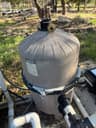
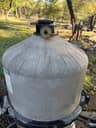
We have a Hayward SwimClear cartridge filter at TerraHills. Below is the process for removing the cartridges, cleaning or replacing them, and getting the system running again.
The actual cartridge swap is only part of the job. Releasing the pressure before opening the tank and reopening the circulation valves before restarting the pump are essential. Do not skip either step.
When Is It Time to Clean or Change Your Pool Filter?
I would look at three things: the pressure gauge, the water flow, and the condition of the cartridges.
Your Filter Pressure Is Higher Than Normal
As cartridges collect dirt, they create more resistance to water flowing through the filter. Hayward's StarClear instructions call for cleaning or replacing the cartridge when pressure rises 7–10 PSI above its clean starting pressure, or when flow drops below the desired rate. Check your particular model's instructions for its service threshold.
For example, if your clean filter normally reads 12 PSI, a 7–10 PSI increase puts its cleaning range at approximately 19–22 PSI. That is an example, not a universal pressure setting for every pool.
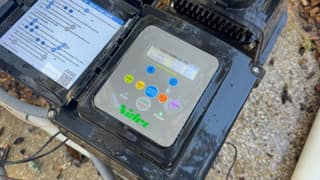
Compare readings at the same pump speed and with the same valve settings. A variable-speed pump's pressure reading changes with its RPM. Comparing a low-speed reading with a high-speed reading will not tell you whether the cartridges are dirty.
Your Return Jets Have Become Noticeably Weaker
Reduced circulation is another reason to investigate. However, low flow does not automatically mean the filter needs replacement. Clogged baskets, restrictions in the plumbing, and air leaks can also reduce flow.
One useful distinction: weak flow with unusually low filter pressure should prompt a check of the skimmer basket, pump basket, and pump operation, rather than an automatic order for new cartridges. I cover that diagnosis separately in why a pool pump runs but does not move water.
Your Pool Is Not Clearing Up
Cloudy water is a reason to check filtration, but it is not proof that the cartridges are worn out. Hayward also recommends checking water chemistry, flow through the filter, and operating time when the water will not clear.
I would investigate those together instead of expecting a new cartridge to solve every water-quality problem.
Should You Replace Pool Filter Cartridges or Just Clean Them?
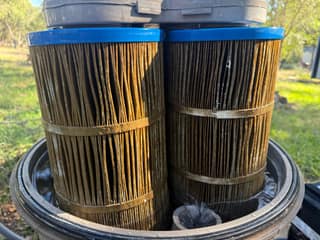
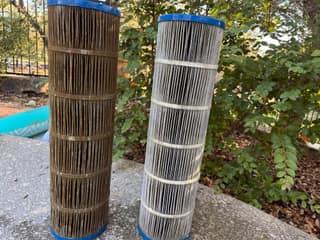
My starting point is simple: clean an intact cartridge first; replace a damaged or exhausted one.
| What you notice | What to do |
|---|---|
| Dirt and debris packed into otherwise intact pleats | Clean the cartridge. |
| An oily coating that a hose does not remove | Use an appropriate cartridge cleaner according to its directions. |
| Pressure returns to its normal range after cleaning | Continue using the cartridge and monitor performance. |
| Proper cleaning no longer restores normal pressure and flow | Check for other restrictions, then consider replacement. |
| Torn filter material, cracked end caps, or a collapsed center core | Replace the damaged cartridge and investigate the cause. |
| Cleaning intervals become much shorter under otherwise similar conditions | Check for ongoing contamination and declining cartridge performance. |
These are the distinctions emphasized in Hayward's cleaning guidance and Unicel's cartridge troubleshooting information.
A quick rinse is not always a complete cleaning. Oils can remain on the material even after the loose dirt is gone, so an appropriate deep cleaning may be worth trying before replacing an otherwise sound cartridge.
At the same time, there is no reason to keep washing a cartridge with torn material or a collapsed core. Cleaning cannot repair that damage.
Before You Start: Identify Your Hayward Filter
"Hayward cartridge filter" is not a specific replacement size. Start with the model number on the tank and the cartridge part number. Hayward molds part numbers into the end caps of its replacement cartridges to help identify them.
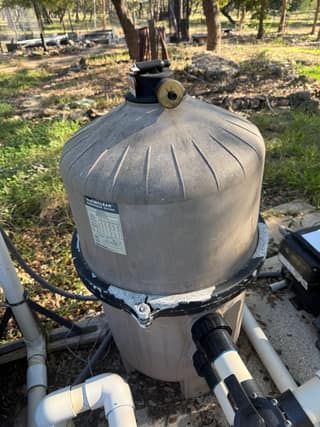
Take a photo of both before shopping. Use the model's parts diagram or a manufacturer's compatibility guide to confirm the replacement. Do not choose a cartridge just because it looks similar. Unicel's replacement finder, for example, begins by identifying the original filter manufacturer.
Also identify how your lid is secured. Hayward filters use different closures: some have a locking knob, some have a threaded locking ring, and others have a metal band clamp. Ours is the band-clamp style. The opening and tightening instructions are not interchangeable.
For the job, have the correct replacement cartridges, or your existing ones to clean, a garden hose, a clean cloth, and whatever tools your exact manual specifies. Some closures require no tools; certain band clamps require a torque wrench.
How to Change a Hayward Pool Filter Cartridge
Safety first: A filter can remain pressurized after the pump stops. Never loosen its closure under pressure. Hayward's SwimClear manual calls for qualified professional servicing; follow your model's requirements and use a pool technician when required or when you are unsure.
Step 1: Turn Off the Pump and Isolate the Filter
Turn off the circulation pumps, disable automatic starts, and disconnect their electrical power at the appropriate breaker or disconnect so they cannot restart during maintenance. Do not rely only on a stopped pump display.
Once the pumps have stopped, position the isolation valves as your system requires to prevent water flowing into the filter. This is particularly important when the equipment is below the pool's water level.
I recommend taking a photo of the normal valve positions first. It gives you a reference when putting everything back.
Step 2: Release All Pressure and Drain the Tank
Open the manual air-relief valve according to your filter's instructions. This is the valve used to vent trapped air, not a reason to unscrew the pressure gauge or remove the entire relief assembly.
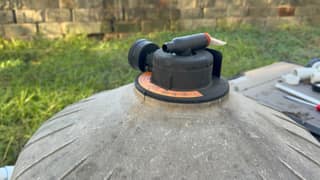
Stand clear and wait until pressure is fully relieved and the gauge reads 0 PSI. Leave the air relief open, then drain the tank through its designated drain as instructed in the manual. Do not use a loosened lid to release pressure.
If you cannot confirm that the tank is depressurized, stop rather than force it open.
Step 3: Release the Locking Ring, Knob, or Clamp
Release the closure used on your model. A threaded ring may have a safety latch that must be disengaged before unscrewing it. A locking-knob filter opens differently from a band-clamp filter.
Follow the exact procedure in the owner's manual. Do not treat the plumbing unions as the lid release.
Step 4: Remove the Lid and Cartridges
Lift off the lid without using the pressure gauge as a handle. On a multi-cartridge SwimClear filter, remove the top manifold, the piece connecting the cartridge openings, before lifting out the individual cartridges.
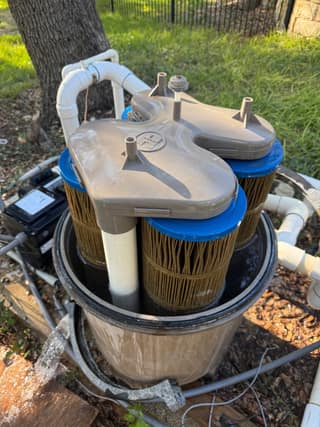
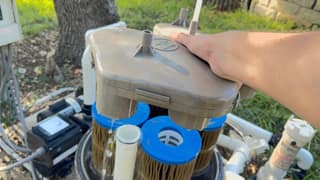
Take a photo of the internal arrangement before removing parts. Set everything somewhere clean where it will not get stepped on or knocked over.
Step 5a: Clean the Existing Cartridges
If you are keeping the cartridges, rinse them thoroughly with a garden hose. Work around the entire cartridge and get the debris out from between the pleats, rather than just making the outside look cleaner.
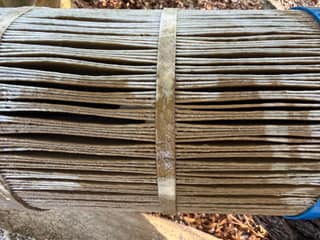
Do not use a pressure washer. Hayward specifically warns against it because it can damage the filter element. A soft brush may be appropriate where the manufacturer permits it; aggressive scrubbing is not the goal.
For oily buildup, use a cartridge-cleaning product approved for the application, follow its label, and rinse thoroughly before reinstalling. The full procedure, including what to do about oils and a cartridge that will not rinse clean, is in how to clean a cartridge pool filter.
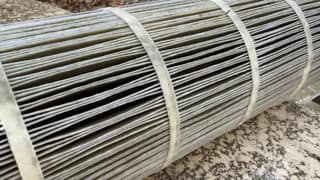
Step 5b: Prepare the New Cartridges
If you are installing new cartridges, skip cleaning the old ones.
Before installation, I would check the part numbers again, remove all packaging, and inspect each cartridge for shipping damage. Unicel notes that even new cartridges can arrive with cracked end caps or other handling damage.
Keep the old cartridges nearby until you have confirmed the replacements are correct.
Step 6: Clean the Tank and Reinsert the Cartridges
Flush debris from the bottom of the tank. Seat the cartridges on their correct supports and reinstall the top manifold where fitted, aligning its connections as the manual specifies.
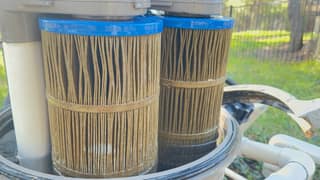
The parts should sit correctly without using the lid to force them into position.
Step 7: Reinstall the Seal and Secure the Lid
Clean the seal and its mating surfaces, then reinstall the lid and closure exactly as instructed.
Do not automatically grease every seal: Hayward specifically says not to lubricate the metal-reinforced seal used in the SwimClear manual. Likewise, follow the specified clamp-tightening procedure rather than assuming hand-tight is sufficient.
On a threaded-ring model, make sure its safety latch is fully engaged before startup.
Step 8: Reopen the Valves, Then Start the Pump
Confirm the drain is closed and return the circulation valves to their normal filtration positions, allowing water to travel from the pool through the equipment and back.
Open the required valves before starting the pump, not afterward. Leave the manual air relief open, prime the pump as its instructions require, stand clear of the filter, and start the system.
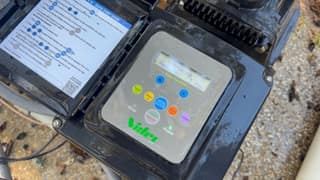
Step 9: Close the Air Relief Once Water Flows Steadily
Wait until the air-relief outlet produces a steady stream of water, rather than air or sputtering air mixed with water. Then close the manual air-relief valve normally.
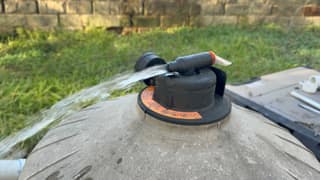
Once operation has stabilized, record the filter pressure and pump speed. That gives you a useful reference for future checks.
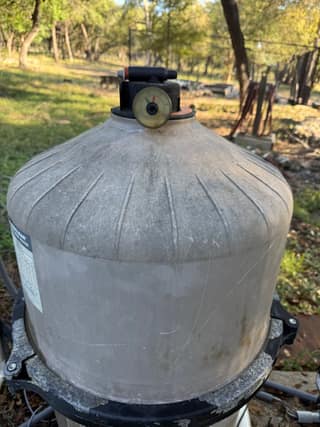
If water leaks around the tank clamp, immediately shut off the pumps and power, stay clear until leakage stops, and follow the manual's depressurization procedure before inspection. Never tighten a leaking clamp while the system is running. See why a pool filter leaks around the lid for what to check.
How Often Should You Clean Your Pool Filter?
For this type of reusable cartridge filter, I would use the manufacturer's pressure and flow criteria as the main trigger, not automatically replace cartridges every month.
Hayward specifies servicing when pressure rises above the clean baseline by the stated amount or when flow falls below the desired rate. It also advises cleaning after vacuuming when necessary.
My suggested habit is to glance at the gauge during your regular pool checks and keep a simple note of the cleaning date, pressure before cleaning, and pressure afterward. I fold that into my weekly pool maintenance routine.
That record helps answer a useful question: Did cleaning restore performance, or am I getting less improvement each time?
Troubleshooting After Cleaning or Replacement
The Pressure Is Still High
First, compare it with your baseline at the same pump speed. Then verify the valve positions and check for restrictions elsewhere in the circulation system. A pressure reading alone does not isolate the cartridges as the cause. I walk through the full checklist in why pool filter pressure is too high.
If the rest of the system is operating correctly and thorough cleaning no longer restores the normal pressure range, replacement becomes more reasonable. That is also the condition-based advice Hayward gives for its C100S replacement element.
The Pump Has Weak Flow and Low Pressure
Check the skimmer and pump baskets, pool water level, and signs of air entering the system. Persistent bubbles or a pump basket that will not stay properly filled need investigation; repeatedly opening the filter will not fix the underlying problem.
The Pressure Rises Again Very Quickly
Do not immediately assume the cartridges are defective. Ongoing algae or other contamination can create short cleaning cycles, while a newly plastered pool can load filters with plaster dust. Check what the filter is collecting as well as the cartridge's condition.
My Takeaway
I would not buy new cartridges simply because the existing ones look dirty. I would clean them, inspect them, and see whether normal performance returns.
The decision is straightforward: keep a sound cartridge that cleans up and works properly; replace one that is damaged or no longer responds to proper cleaning.
And take the reassembly seriously. The last few minutes, checking the seal, securing the closure, restoring the valves, and safely venting the air, matter just as much as the cartridge swap itself.
Frequently asked questions
How long do pool filter cartridges last?
There is no guaranteed lifespan for every pool. As a reference, Pentair gives an average of about three years under normal conditions for its Clean & Clear Plus cartridges. That is not a replacement deadline for a Hayward filter. Judge yours by condition, cleaning results, and the manufacturer's guidance.
Can you backwash a cartridge pool filter?
The cartridge filters discussed here are cleaned by removing and washing the elements, not by routine backwashing. Pentair specifically describes its Clean & Clear Plus as requiring no backwashing, and Hayward's SwimClear works the same way.
Do you need to drain the pool to change the filter?
No. You drain the filter tank, not the pool. Equipment that sits below the water level needs proper isolation so pool water does not flow into the opened filter. Follow the valve arrangement and servicing procedure for your installation.
Can you pressure-wash pool filter cartridges?
No. Use a garden hose and the cleaning method the manufacturer specifies. Hayward warns that pressure washing can damage the element. Getting it clean is not worth tearing up the material that does the filtering.
Should you soak cartridges in muriatic acid?
Not as routine cleaning. Acid treatment is for specific deposits and requires the correct manufacturer-approved procedure. Unicel warns that acid washing without first removing oils and cleaning residue can permanently restrict the material. Start with rinsing and an appropriate cartridge cleaner, not an improvised acid bath.
Does a broken support band mean the cartridge is ruined?
Not necessarily. Unicel says a broken band alone does not automatically require replacement. Inspect the pleats, end caps, and core, and judge the cartridge by its performance rather than by one band.
What should the pressure gauge read when the pump is off?
After the system is shut down and pressure has been fully relieved, the gauge should return to zero. A gauge that stays stuck, is unreadable, or does not respond needs attention. Do not assume a faulty gauge makes the tank safe to open.