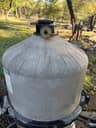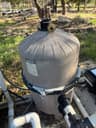
On this page
A cartridge filter that was dry for years and starts leaking the day after a cleaning is not a coincidence. Opening the tank disturbs the seal, the closure, and the mating surfaces, and any one of them not going back exactly right shows up as a drip or a spray at the seam.
The fix is usually simple. The procedure for getting to the fix is where people get hurt, so start there.
Stop the Pump Before Anything Else
A filter tank is pressurized when the pump runs. If you see water at the clamp, ring, or lid while the system is on, shut the pump off and cut its power. Stay clear of the tank until the leaking stops. Then open the manual air relief and wait for the gauge to read zero before you touch the closure.
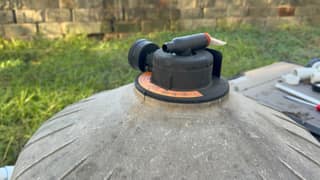
Do not tighten a leaking clamp while the pump runs. Hayward's SwimClear manual is explicit on this, and the reason is that a clamp holding back pressure can release suddenly when it is disturbed. Tightening a knob or ring under pressure carries the same risk.
Find Exactly Where the Water Comes From
Once it is depressurized and dry, wipe the tank down and look. The usual sources, roughly in order:
- The tank seam, where the lid or upper half meets the lower half under the clamp or ring.
- The air relief or pressure gauge threads on top of the tank.
- The drain plug or valve at the bottom.
- Plumbing unions at the inlet and outlet.
- A crack in the tank, lid, or clamp.
Each has a different fix, and the seam is the one most often disturbed by a cleaning.
Why the Seam Leaks After a Cleaning
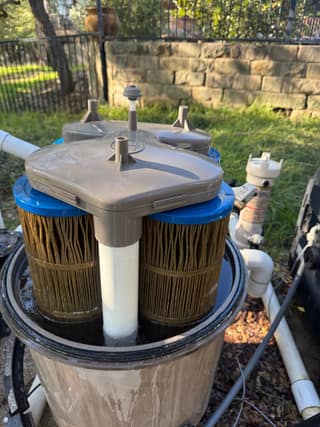
Debris on the seal or lip. Rinsing cartridges next to the tank throws dirt around. A bit of it lands on the seal groove or the tank lip, and the seal cannot seat. Wipe both surfaces clean before closing.
Seal not seated evenly. A large seal can twist or sit proud on one side as the lid goes on. Run a finger around it and confirm it is fully in its groove all the way around before the closure is tightened.
Lubrication the manual did not ask for. Some filters want a silicone pool lubricant on the O-ring. Hayward says not to lubricate the SwimClear's metal-reinforced seal. Grease on a seal that is designed to run dry can let it slip under clamp load.
Closure not tightened to specification. Band clamps often have a torque value in the manual, and a threaded ring has a stop or safety latch that must be fully engaged. Hand-tight is not a spec. Follow the procedure.
A worn or damaged seal. Seals flatten, crack, and take a set over years. If it is visibly deformed, nicked, or no longer rounded, replace it with the manufacturer's part.
Reseating the Seal and Closure
With the tank depressurized and drained:
- Release the clamp, ring, or knob per the manual and lift the lid off. Do not use the gauge as a handle.
- Remove the seal. Clean the seal, its groove, and the tank lip with a cloth and clean water. Check all three for debris, scoring, and cracks.
- Inspect the seal. Replace it if it is flattened, cut, or deformed.
- Refit the seal dry unless the manual specifies a lubricant, and confirm it sits evenly all the way around.
- Set the lid on squarely. Do not force it with the clamp; if it does not sit, lift it and check for a cartridge or manifold that is not fully seated underneath.
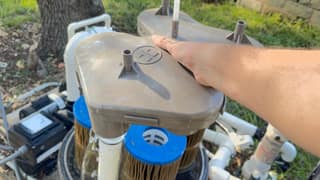
- Close the clamp or ring following the manual's sequence and torque. Engage any safety latch.
- Close the drain, reopen the circulation valves, leave the air relief open, and start the pump.
- Close the relief when it produces a steady stream of water. Then watch the seam for a few minutes at normal pressure.
The full open-and-close sequence, including what to photograph before you take things apart, is in how to change a pool filter cartridge.
Leaks That Are Not the Seam
Air relief or gauge threads. These seal with a tapered thread or a small O-ring. A slow weep here usually means the fitting backed off or the O-ring is worn. Depressurize, remove the fitting, clean the threads, and reinstall with the sealing method the manual specifies.
Drain plug. Same approach: depressurize, remove, check the O-ring, refit. Do not overtighten a plastic plug.
Unions. A union that drips after a service was usually disturbed while the tank was open. Depressurize, back the nut off, check that the O-ring is seated and not pinched, and hand-tighten plus the small turn the manual allows. Never loosen a union to relieve pressure.
When It Is a Crack
A hairline crack in the tank, lid, or clamp is not a seal problem and does not get sealant. A cartridge filter is a pressure vessel, and a crack is a defect in it. Replace the damaged component with the manufacturer's part, or replace the filter. Do not run it in the meantime.
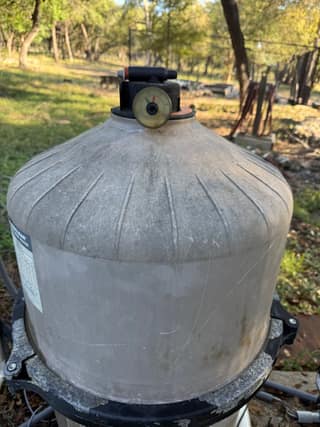
The same goes for a clamp with a damaged bolt, a stripped thread, or a bent band. The chipped paint on our clamp is cosmetic; a kink or a crack in the metal would not be.
Checking Before Trouble Starts
A leak that shows up on its own, with no recent service, usually means an aging seal or a fitting that worked loose. I look at the seam, the top fittings, and the drain during my weekly pool maintenance and wipe a hand around the clamp. A damp spot that was not there last week gets a shutdown and a proper look before it gets worse.
Frequently asked questions
Is it safe to tighten the filter clamp while the pump is running?
No. A cartridge filter tank is under pressure when the pump runs. Hayward's SwimClear manual says to shut the pump off, stay clear until the leak stops, and relieve pressure before inspecting a leaking clamp. Tightening a clamp on a pressurized tank risks the closure letting go.
Why is my pool filter leaking after I cleaned it?
The usual causes are a seal that was not seated evenly, debris or sand on the seal or the tank lip, a seal that was lubricated when the manual says not to, a clamp or ring that was not closed to specification, or a safety latch left disengaged. Depressurize, open it again, clean the surfaces, and reassemble per the manual.
Should I grease the filter tank O-ring?
Only if your manual says to. Some filters call for a silicone-based pool lubricant on the O-ring. Hayward specifically says not to lubricate the metal-reinforced seal on the SwimClear. Follow the instructions for your model rather than a general rule.
Can a cracked filter tank be repaired?
Not safely with sealant or epoxy. A tank or lid with a crack is a pressure vessel with a defect. Replace the damaged part with the manufacturer's replacement, or replace the filter. Do not run a filter with a cracked tank.
What if the leak is at a pipe fitting instead of the lid?
Unions, the drain plug, the air relief, and the pressure gauge all have their own seals. Depressurize, identify exactly where the water is coming from, and service that fitting. Do not loosen a union as a way of relieving pressure.