


The verdict · Dolphin Cayman
The Cayman is easy to recommend because it automates the part cheaper robots leave manual. It starts on a schedule, climbs the walls, scrubs with an active brush, and carries a large top-loading basket. It does not travel along the waterline, and I would add the NanoFilter panels, but the core cleaner gets a lot right.
What works
- Weekly timer starts a cycle daily, every other day, or every third day
- Top-loading MaxBin holds over 50% more debris than older Dolphin cartridges
- Climbs and scrubs the pool floor and walls
- Active HyperBrush spins faster than the robot moves
- Optional NanoFilter panels catch finer debris
What doesn't
- It reaches the top of the wall but does not scrub sideways along the waterline
- NanoFilter panels are a separate purchase and take some assembly
- No app, remote control, or anti-tangle cable swivel
Dolphin Cayman — key specs
| Recommended pool size | Above-ground or in-ground pools up to 33 feet |
|---|---|
| Coverage | Floor and walls; no waterline scrubbing |
| Cycle time | 2 hours |
| Scheduling | Weekly timer: daily, every other day, or every third day |
| Filtration | Top-loading Gen-2 MaxBin with standard fine filters; optional NanoFilter upgrade |
| Scrubbing | One active HyperBrush |
| Drive | Dual DC motors with HyperGrip tracks |
| Suction rate | 4,000 gallons per hour |
| Robot weight | About 14.6 pounds |
| Connectivity | No app or remote control |
| Warranty | 2 years |
On this page
The first thing I liked about the Dolphin Cayman was not the wall climbing or the oversized basket. It was the timer.
That sounds like a small detail until you own a robot without one. If I have to walk outside and press start before every cycle, pool cleaning is still on my list. The Cayman's power supply can start the robot every day, every other day, or every third day. I set it, leave the cord in place, and deal with the basket when it is full.
The rest of the machine is well matched to that schedule. The active brush scrubs instead of coasting over the floor, the tracks carry it onto the walls, and the MaxBin has enough room for more than a light dusting of debris. After more than a month with it, the Cayman felt less like a budget model with one nice feature and more like a smaller version of the Dolphins I usually recommend.
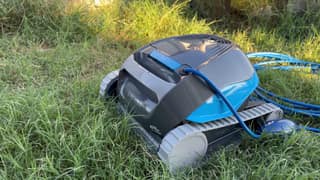
What's Included
The Cayman comes with:
- the Dolphin Cayman robot;
- a power supply with the weekly timer;
- a MaxBin with standard fine filter panels;
- a manual and quick-start guide;
- a two-year warranty.
There is no app, remote, or caddy in the standard package. The optional NanoFilter panels are sold separately.
Weekly Timer
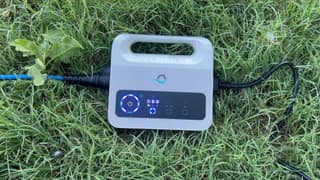
The timer is simple. I choose a two-hour cycle every day, every other day, or every third day. It runs that schedule for the next week, then I set it again when I rinse the filter. There is no account to create and no app connection to lose.
I prefer that arrangement to a battery robot for one practical reason: the Cayman is ready for the next cycle. A cordless cleaner has to come out, drain, recharge, and go back in. The Cayman's cable is not as tidy, but it gives the robot steady power and lets the timer do its job.
Scheduling is one of the first features I look for in a robotic pool cleaner, and it is one of the main criteria in my 2026 list of the best robotic pool cleaners. Buying a robot removes less work if I still have to manage every cycle myself.
MaxBin
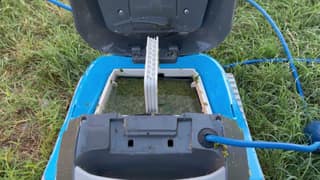
The Cayman uses the Gen-2 MaxBin introduced with Dolphin's Max-Series. Maytronics says it holds over 50% more debris than its older Gen-1 cartridge arrangement.
That extra volume mattered when I used the Cayman in dirty water. The basket filled with algae and loose debris, but I could still lift it straight out through the top and see exactly what the robot had collected. I did not have to flip the cleaner over or pull apart a pair of small cartridges.
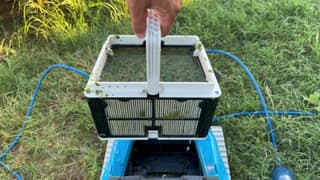
A tab releases the bottom when it is time to dump the bin. The design is not spotless—fine algae still takes a thorough hose rinse—but it is quick to open, easy to inspect, and much nicer to handle than a fabric bag.
Optional NanoFilter Upgrade
The standard fine filters handle leaves, bugs, and ordinary dirt. Dolphin also sells NanoFilter panels for smaller material such as pollen, silt, and dead algae. My Dolphin NanoFilter guide shows what the pleated media caught that standard mesh sent back into the pool.
The upgrade gives the Cayman much better fine-particle filtration, but it is not included in every package. Assembly is also more involved than on the larger XXL MaxBin used by the Dolphin Quantum: two panels are held in place with screws instead of all four snapping in.
That is a one-time annoyance rather than an everyday problem. Once the panels are installed, the basket still lifts out and rinses from the top.
Wall Climbing
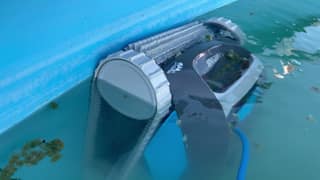
The Cayman repeatedly moved from the floor onto the wall without any setup from me. In the above-ground pool, it climbed until part of the body broke the surface, then dropped back down and continued its route. That was enough to scrub algae above the floor instead of leaving me the entire wall.
There is an important limit here. Reaching the top is not the same as cleaning the waterline. The Cayman does not turn sideways and track along the tile line. The Dolphin Premier does; the Cayman gives me useful wall coverage without pretending to be that kind of cleaner.
HyperGrip Tracks and Dual Motors
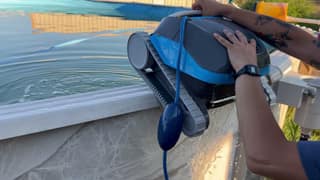
The wall climbing comes from the Cayman's dual DC motors and rubber HyperGrip tracks. The motors drive the track system directly, so the robot can keep traction while the intake and brush work.
Tracks also spread contact across a larger area than small wheels. The Cayman stayed planted on the floor instead of floating over dirt, then carried that grip onto the walls.
The direct drive was most noticeable when the robot changed direction. It pivoted without a long burst of wheelspin, then went back to scrubbing instead of stirring the debris into the water.
Cleaning Performance
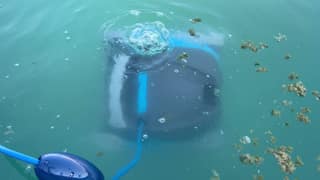
Once it settled, the Cayman left visible tracks through the algae on the floor. The brush broke material loose, the intake pulled it into the bin, and the cord kept the suction from tapering off late in the cycle. One pass did not rescue a neglected pool, but every pass removed a load I otherwise would have vacuumed by hand.
That is the kind of performance I want from a scheduled cleaner. On routine weeks it can run with very little help. On a heavy cleanup I still check the bin after each cycle, because no oversized basket is useful once the filter is packed.
The missing waterline mode is the main coverage tradeoff. I still had to brush the tile line myself, just as I still brush shallow steps before running most full-size robots.
HyperBrush
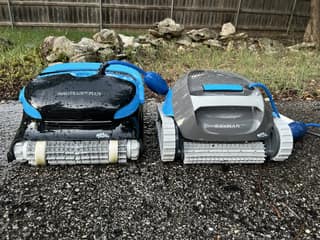
The Cayman's HyperBrush rotates at roughly twice the speed of the robot's forward movement. Rather than rolling passively across the surface, it agitates dirt and algae before the intake pulls them into the basket.
Side by side with the Dolphin Nautilus CC Plus, the faster brush action was easy to see. The Cayman was more aggressive over algae and dirt that had settled into the pool finish.
Comparable Robots
The Dolphin Nautilus CC and Dolphin Explorer E20 also clean the floor and walls, but their basic power supplies leave more of the schedule to the owner. They make sense when the lower price matters more than automatic starts.
The Dolphin Escape uses a similar MaxBin and active brush in a lighter floor-only cleaner for above-ground and smaller in-ground pools. Its standard power supply does not include a timer, although some dealer packages add one.
The Dolphin Premier is the step up for waterline scrubbing, an anti-tangle swivel, several filter-media choices, and a three-year warranty. It costs much more than the Cayman.
The Clear UV adds waterline cleaning, app scheduling, finer filtration, and UV-C treatment. It is a premium alternative rather than a direct price competitor.
Where to Buy
The Cayman package is not identical at every dealer. Some listings include only the standard MaxBin, while others bundle NanoFilters, a caddy, or both. I would compare the full package rather than the sale price alone.
The dealer buttons in the verdict above go to current Cayman listings from Poolbots, PoolRobots, PremierRobotic, and QuantumRobotic. Those are also the four retailers I use for the other Dolphin models mentioned in this review.
Final Thoughts
The Cayman makes sense because none of its best features feel wasted. I use the timer. I need the basket space. I can see the active brush working, and I watched the tracks carry it onto the wall.
I would still budget for NanoFilters if the pool gets pollen, fine silt, or dead algae, and I would buy a different robot if waterline scrubbing is non-negotiable. For a scheduled floor-and-wall cleaner without the price or fuss of a premium app model, the Cayman is the one I would choose.
Frequently asked questions
Does the Dolphin Cayman climb walls?
Yes. The Cayman cleans the pool floor and climbs the walls. It can reach the top, but Maytronics does not rate it for waterline scrubbing, so it will not travel sideways along the tile line like a higher-end waterline model.
How does the Dolphin Cayman weekly timer work?
Buttons on the power supply let you schedule a two-hour cycle every day, every other day, or every third day for the coming week. The schedule then needs to be set again for the next week.
Is the Dolphin Cayman cordless?
No. It is a corded cleaner. The cable provides steady power through every cycle and lets the weekly timer start the robot without a recharge.
Does the Dolphin Cayman include NanoFilters?
No. The standard Cayman includes the MaxBin with fine filter panels. NanoFilter panels are an optional upgrade for finer particles such as pollen, silt, and dead algae.
How long is a Dolphin Cayman cleaning cycle?
The default cleaning cycle lasts two hours. Current dealer listings rate the Cayman for above-ground or in-ground pools up to 33 feet long.


