


The verdict · Dolphin Premier
In more than four years, I only replaced the tracks, brushes, and filter media. The ProLine hardware, interchangeable leaf bag, and sideways waterline scrubbing made the Premier my most dependable pool robot. It could never clean my shallow steps.
What works
- Mine spent four years in chlorine and Texas sun without a major ProLine component failing
- Oversized leaf bag handles heavy fall debris without clogging
- NanoFilters catch pollen and silt that slip through mesh filters
- Moves sideways along the tile line instead of dropping after each wall climb
- The weekly timer starts each cleaning for pennies per cycle
- Its 3-year warranty beats the current Nautilus CC Plus warranty of one year
What doesn't
- It can't clean shallow steps or ledges under roughly 15 inches of water
- The NanoFilters need a long rinse after debris-heavy cycles
- $2,499 list price is much higher than residential-grade models
Dolphin Premier — key specs
| Class | Maytronics ProLine; commercial-grade components |
|---|---|
| Motors | Dual commercial-grade DC motors |
| Filtration | 4 swappable options: oversized leaf bag, NanoFilters, standard, and fine |
| Navigation | SmartNav path mapping with anti-tangle swivel cable |
| Coverage | Floor, walls, and waterline scrubbing |
| Scheduling | Power-supply timer (daily / every 2 / every 3 days) |
| Warranty | 3 years |
| Power | Corded; plugs into a standard 120V GFCI outlet and costs pennies per cycle |
| List price | $2,499; frequently on sale for a few hundred less |
On this page
Before moving to a robot, I used a Polaris 360 pressure-side cleaner. It taught me that "hands-off" pool cleaning always has limits. The debris changes with the seasons, my pool has awkward curves, and chlorine and Texas sun wear on everything.


The Dolphin Premier handled all of that better than most machines I've owned. I ran mine for more than four years in a kidney-shaped pool through daily debris, heavy fall leaves, and thick Texas pollen every spring. It earned its price on the floor and walls, though I still had to help it with the shallow steps.
I've since replaced it with the Clear UV (see my Clear UV vs. Dolphin Premier comparison), but the Premier was still running when I made the switch. The only parts I'd put into it were routine wear items. I'd still recommend it if you want a scheduled corded cleaner and don't need it to cover the steps.
Why I Chose It Over the Nautilus CC Plus
Before buying the Premier, I compared it closely with the cheaper Dolphin Nautilus CC Plus. See my full Dolphin Premier vs. Nautilus CC Plus comparison for the head-to-head breakdown. The CC Plus cleans floors and walls and has plenty of positive owner reviews. I chose between them on product class, warranty, and motors.
I have since used the CC Plus in a separate cleanup. My Dolphin Nautilus CC Plus review explains the current Wi-Fi model, its one-year U.S. warranty, and the differences between listings that share the name.
| Feature | Dolphin Premier | Dolphin Nautilus CC Plus |
|---|---|---|
| Classification | ProLine (commercial-grade components) | Standard residential |
| Warranty | 3 years | 1 year (recently downgraded) |
| Motors | Dual commercial-grade DC motors | Standard DC motors |
| Waterline cleaning | Yes; scrubs and moves along the tile line | No; climbs the wall, then falls back |
| Filter media options | 4 (leaf bag, NanoFilters, standard, oversized) | 2 (standard, ultra-fine) |
The warranty settled it. Maytronics cut the Nautilus CC Plus warranty to one year, and that felt too short for an expensive machine that spends its life in chlorinated water. The Premier is part of Dolphin's ProLine series, with commercial-grade dual steering motors, heavier parts, and a 3-year warranty.
It also handles the waterline differently. The CC Plus climbs the wall and drops back, while the Premier reaches the surface and moves sideways along the tile. With all the fall debris in my pool, I wanted the longer warranty, heavier hardware, and fuller wall coverage.
Build Quality and the Adjustable Handle
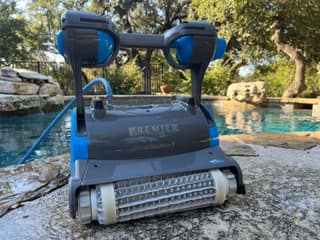
The Premier is heavy, and that weight helps keep the tracks against slippery pool walls. Its housing also feels thicker than the plastic on many big-box-store robots. After four years of chlorine, Texas sun, and trips in and out of the water, mine still looked good.
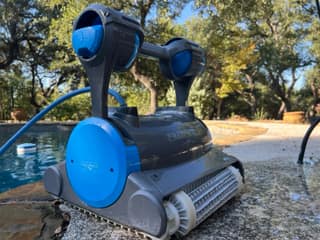
The dumbbell-shaped bar across the top doubles as the carry handle and the waterline adjustment. I could lock it at an angle to change how the robot pushed away from the wall. Blue floats kept the handle within reach and helped the cable feed from above instead of dragging under the tracks.
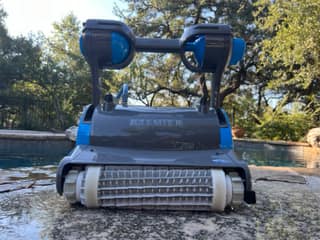
Wide powered brushes run across the front. They scrub while the intake vacuums, and I could see the brush marks on my floor after a cycle.
Why Corded Power Worked Better for Me
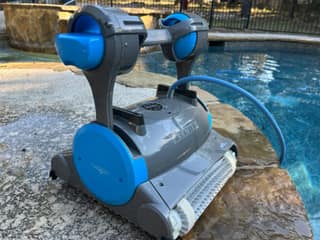
The Premier has a cord, which I prefer to the battery-powered robots I've tried. Cordless models lose capacity over time, can slow as the charge falls, and have to come out of the pool for charging after every use.
Because the power never dropped, the Premier kept the same suction through a full cycle and never died in the deep end. Its blue cable has an anti-tangle swivel, and in four years I never found it knotted. The tether still needs room around the pool, but it never kept the robot from covering mine.
Interchangeable Filters for Leaves and Silt
The filters sold me on the Premier. Many robots give you either a fine pleated filter that fills quickly with leaves or a mesh net that lets silt through. The Premier takes both, plus an oversized leaf bag. I could swap them in seconds: unlatch the bottom plate, put in the filter I needed for that day's debris, and close it up.
The Oversized Leaf Bag
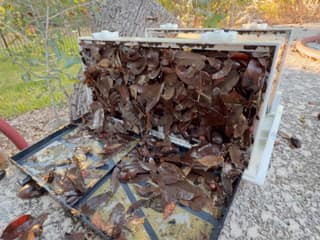
My pool gets buried in leaves every fall. Before the Premier, I spent as much as an hour a day skimming and vacuuming or stopping to clear the small inline filter on my Polaris 360.
With the leaf bag installed, the Premier picked up whole oak leaves, twigs, and acorns without clogging the intake. The packed bag in the photo came from one cycle during peak leaf drop; that load would've filled a standard cartridge quickly. I opened the compartment, dumped the bag into the flower bed, rinsed it, and put the robot back in the pool.
NanoFilters and Spring Pollen
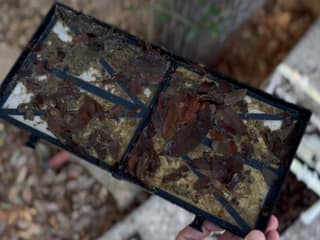
In spring, pollen takes over. Pollen, fine sand, and dead algae can slip through mesh, blow back out of the exhaust, and settle on the floor again.
The deep pleats in the NanoFilter panels catch those small particles. After a heavy cycle, mine came out coated in yellow pollen and silt like the panel above.
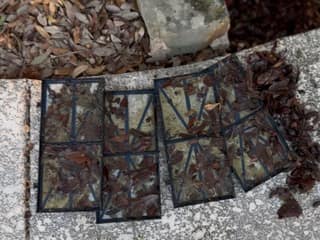
Fine debris packs deep into the NanoFilters, so a quick rinse isn't enough after a heavy cycle. A long hose-down takes more time, but those filters left my water clear and polished. I could still switch from the leaf bag to fine filtration in less than a minute.
Navigation in a Kidney-Shaped Pool
A kidney-shaped pool isn't an easy route for a robot. Mine has curves, deep-end slopes, and a gradual change from shallow to deep water, all places where a robot can miss dirt more easily than it would in a rectangle.
The Premier's SmartNav software maps a path instead of bouncing around at random. Its passes overlap slightly so it doesn't leave narrow strips of dirt. At my pool's curved sides, the dual motors let it pivot and keep going.
Wall Climbing and the Waterline
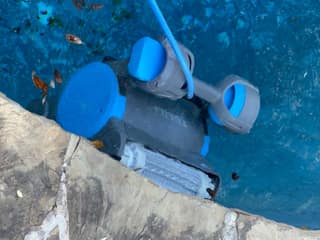
The weight and rubber tracks gave my Premier enough grip to drive straight up the walls. At the surface, it moved sideways while scrubbing the tile line, then reversed into the pool. It cleaned the waterline ring on every cycle and kept my tile looking brushed for four years.
Shallow Steps and Tanning Ledges
The Premier couldn't clean my shallow steps and ledges.
Its size and safety logic keep it out of water shallower than roughly 15 inches. When too much of the body comes out of the water, it backs up to protect the motor. Standard pool steps are also too narrow to hold both tracks.
Before a cycle, I spent about 30 seconds brushing dirt off the steps and ledge into the main pool, where the robot could pick it up. Most full-size robots have the same problem. If you have a large sun shelf, plan on doing some brushing by hand.
Scheduling and Running Costs
My Polaris 360 only moved when the main pool pump, or a dedicated booster, ran at high RPM. That used more electricity and put more wear on the plumbing.
The Premier runs separately from the pool pump and filter. It plugs into a standard 120V GFCI outlet, converts that power to low-voltage DC, and costs pennies per cycle. Over four years, the electricity savings over my Polaris covered the robot's cost.
The timer on the power supply can run the Premier every day, every other day, or every third day. I left mine in the pool during the week and used the every-other-day setting. It started each cycle without me, much like my Ring Security system handles its own schedule.
Parts Replaced After Four Years
Chlorine, acid, and direct sun are hard on plastic and sealed electronics. Even so, my Premier ran for more than four years without a major mechanical failure. I didn't notice any loss of motor power or suction.
I replaced three types of wear parts:
- Filter media: Loading and rinsing wear down the standard panels and NanoFilters. I replaced the NanoFilters once.
- Rubber tracks: Around the third year, the tracks stretched, lost some tread, and slowed down on the walls. A new set cost about $40, took ten minutes to install, and gave the robot its vertical grip back.
- Brushes: I replaced the scrubbing brushes at the same time as the tracks.
I never had to repair the power supply, cable swivel, motor box, or impeller during those four years.
Verdict After Four Years
If you're replacing a manual vacuum, suction cleaner, or pump-dependent pressure-side system, the Dolphin Premier is the one I'd buy. Its $2,499 list price is high, but mine ran for more than four years. The ProLine hardware, 3-year warranty, interchangeable filters, and sideways waterline cleaning gave me plenty for the money.
It covered my kidney-shaped pool, picked up large fall leaves, and filtered fine spring pollen. The weekly timer meant I didn't have to start every cycle. Shallow water was the weak spot: I still had to brush the steps and ledges by hand.
I eventually handed the job to the Clear UV, which adds UV-C sanitation and a higher flow rate. The Premier is the machine that convinced me a robotic cleaner could last, and after four years with it, I'd buy it again.
A surface skimmer like the Betta SE also gives the Premier less work. Leaves caught before they sink never reach the robot's filter, and running both made my pool much less hands-on.
Where to Buy
PremierRobotic.com's Dolphin Premier product page lists it at $2,499, though it's often discounted by a few hundred dollars. The price includes free 1–3 day shipping, a 30-day trial with no restocking fee, and the full 3-year ProLine warranty. I'd also check authorized Dolphin dealers such as Poolbots and PoolRobots before buying.
Compare the Dolphin Premier
- Clear UV vs. Dolphin Premier: The Filter Decides It An owner comparison of the Clear UV and Dolphin Premier covering filters, leaves, waterline cleaning, controls, upkeep, warranty, and current price.
- Dolphin Premier vs. Cayman: Leaf Bag or Easier Basket? An owner comparison of the Dolphin Premier and Cayman covering leaf capacity, filter access, waterline cleaning, brushes, weight, timer, warranty, and price.
- Dolphin Premier vs. Escape: Two Different Pool-Cleaning Jobs A practical Dolphin Premier vs. Escape comparison covering pool fit, cleaning limits, filters, maintenance, scheduling, warranty, and current pricing.
- Dolphin Premier vs. Nautilus CC Plus: Is the Upgrade Worth It? Dolphin Premier vs Nautilus CC Plus compared on waterline coverage, debris handling, controls, warranty, long-term use, and current price.
All comparisons Best Robotic Pool Cleaners All robotic pool cleaners


