


On this page
We spent $20,000 paving our driveway. A year later, it was time to think about maintaining it.
Our asphalt contractor's price to seal approximately 6,000 square feet was $2,000, including preparation, crack filling, and cleanup. That works out to about 33 cents per square foot.
We used the same contractor who paved the driveway, but we still asked questions. What product would he use? Would he spray it or brush it? Were repairs included? And what happened if the coating peeled?
Those details matter more than simply getting a price to "make the driveway black again."
Here's what our contractor specified, why we waited a year, what asphalt driveway sealing actually does, and what we would ask before scheduling the next application—including one important distinction between one heavy coat and two separate coats.
If you haven't read it yet, start with why we chose asphalt for our Texas driveway in the first place. This is the follow-up.
Our Driveway Sealing Cost and Project Details
| Project detail | Our driveway |
|---|---|
| Location | Texas |
| Area used for the sealing price | Approximately 6,000 square feet |
| Original asphalt paving cost | $20,000 |
| Time before first sealcoating | One year |
| Sealcoating price | $2,000 |
| Effective price per square foot | Approximately $0.33 |
| Product specified | Neyra Jennite AE asphalt emulsion |
| Contractor's coating plan | One heavy coat |
| Preparation and cleanup | Included |
| Crack filling before sealing | Included |
| Application method | Broom at concrete transitions; spray elsewhere |
| Application warranty offered | Peeling or flaking related to application |
The coating plan in that table is what our contractor specified, not a recommendation that every driveway should receive one heavy coat. We'll explain that distinction below.
How Much Should Asphalt Driveway Sealing Cost?
For our project, the calculation was straightforward:
$2,000 ÷ 6,000 square feet = approximately $0.333 per square foot.
The total price included more than applying the sealer. Our contractor included preparation, filling cracks beforehand, and cleaning up afterward.
That's important when comparing estimates. A lower number isn't necessarily a better deal if the contractor adds those items later.
What different rates would mean for our driveway
These are mathematical comparisons for a 6,000-square-foot driveway—not quotes for identical work.
| Whole-project rate | Cost for 6,000 square feet |
|---|---|
| $0.20 per square foot | $1,200 |
| $0.25 per square foot | $1,500 |
| Our actual project rate | $2,000 |
| $0.40 per square foot | $2,400 |
| $0.50 per square foot | $3,000 |
| $0.75 per square foot | $4,500 |
For context, Fix Asphalt publishes a $0.20–$0.50 per-square-foot commercial sealcoating range. That makes a useful large-area comparison, but it is not a survey of Texas residential driveway prices. Smaller residential projects and different scopes can price considerably differently.
Our advice is to treat published rates as a starting point—not a reason to assume every higher quote is overpriced.
The product, number of coats, repair work, access, and contractor's minimum charge all affect the comparison. SealMaster specifically identifies area, geography, pavement repairs, product, and coat count as pricing factors.
We would rather compare two complete written proposals than choose between two unexplained prices.
Driveway Sealing Cost Calculator
Use the calculator below to enter your driveway's square footage, adjust the example rates, and add any separately priced repairs or fees.
It also shows what your area would cost at our exact project rate.
Driveway sealing cost calculator
Enter your asphalt area, adjust the example rates, and add anything priced separately. Every number updates as you type.
Results
- Estimated range at your rates
- $1,200–$3,000
- Your area at our project rate
- $2,000$2,000 ÷ 6,000 sq ft, applied to your area
- Effective rate of your quote
- $0.3333 per sq ftTotal quote ÷ area
The low and high presets are illustrative large-area comparisons, not verified Texas residential averages. Rates should represent the complete quoted job, so don't add preparation or crack filling as extras when a quote already includes them.
A two-coat job is not automatically double the price. Ask for a complete two-coat quote instead of multiplying.
The comparison is not a quote, and it does not mean your driveway needs the same work. In particular, our contractor's one-heavy-coat scope should not be treated as interchangeable with a manufacturer-specified two-coat application.
Why We Waited One Year Before Sealing
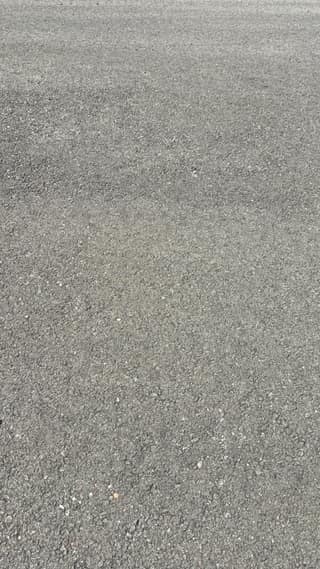
We did not seal the driveway immediately after paving. We waited a year.
That gave us a straightforward maintenance point without rushing to coat brand-new asphalt.
But one year is our timeline—not a universal rule that every homeowner must follow.
The Colorado Asphalt Pavement Association advises waiting until a new driveway is at least several months old before sealing. Product instructions can be more specific: Jennite AE's published data sheet gives a 30-day minimum, together with a surface-readiness test that checks how clean water spreads across the asphalt.
Those recommendations aren't the same as saying every driveway should be sealed on day 30.
The surface must be ready, the product must be appropriate, and the application weather must cooperate.
For us, waiting a year made sense. For another driveway, we would ask the paving contractor and sealer manufacturer to explain the timing rather than relying on a calendar alone.
What Does Asphalt Sealcoating Actually Do?
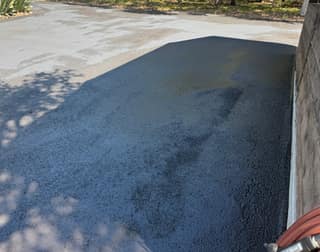
Sealcoating adds a protective surface treatment to existing asphalt. It can help reduce exposure to water and weathering while restoring a darker, more uniform appearance. It is maintenance—not another layer of structural pavement.
That distinction is essential.
Sealing is not repaving.
A coating won't correct a sinking driveway, rebuild a weak base, or change the slope so water drains properly. Neyra's pavement guidance distinguishes surface maintenance from problems such as rutting, extensive interconnected cracking, and standing water that require other repairs.
Our goal was to maintain the driveway we had already paid to install—not pretend that sealcoating could replace proper construction.
The Product Our Contractor Specified: Neyra Jennite AE
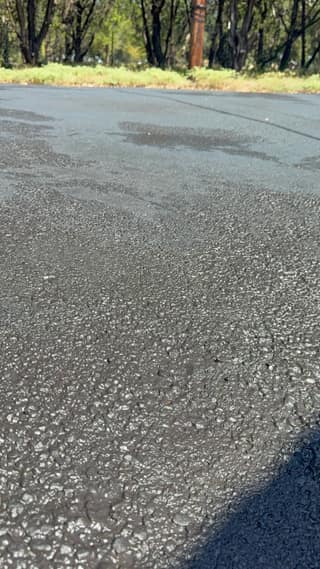
We asked for the actual product name, not just "commercial-grade sealer."
Our contractor specified Neyra Jennite AE, an asphalt-emulsion pavement sealer.
Neyra describes it as a polymer-modified coating for asphalt driveways and other paved surfaces. The AE formulation contains no coal tar.
The complete name matters. Neyra also markets a different product called Jennite, without the AE suffix, that is coal-tar-based. We would make sure the written proposal identifies the exact formulation being supplied.
Why asphalt emulsion matters to us
We liked having a clearly identified asphalt-emulsion product rather than an unspecified coating.
Asphalt-based sealants generally contain much lower concentrations of polycyclic aromatic hydrocarbons, or PAHs, than coal-tar-based sealants. That distinction is documented by the Minnesota Pollution Control Agency.
But "no coal tar" does not mean "no precautions."
Jennite AE has a safety data sheet with handling, protective-equipment, and cleanup requirements. We would keep children and pets away from the work area and wet coating, and expect the contractor to contain waste properly.
One Coat vs. Two Coats: The Detail We Would Clarify
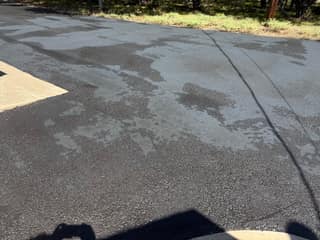
Our contractor told us he would apply one heavy coat.
That sounds reassuring at first. More material in one application can sound equivalent to applying it twice.
But those are not automatically the same thing.
Neyra's published Jennite AE NJ-S2 specification calls for two coats in low-to-moderate-traffic applications, with the first allowed to dry thoroughly before the second.
That is different from our contractor's described approach.
Why a heavy coat isn't automatically better
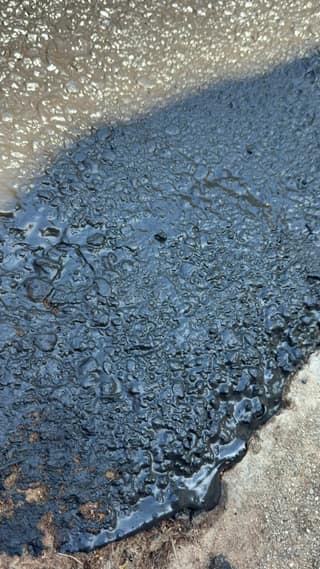
With water-based driveway coatings, thicker is not necessarily better. Latex-ite explains that excessive thickness can retain water, slow curing, and cause tracking or surface cracking. Its guidance favors properly applied thin coats over one excessively thick application.
That doesn't establish that our contractor's application failed. We don't have the measurements or manufacturer approval needed to make that judgment.
It does mean we would not tell another homeowner:
One heavy coat is always just as good as two.
Instead, our question would be:
"Can you show us the manufacturer's instructions supporting this application—or get written confirmation for this specific project?"
Neyra makes custom specifications available, so a contractor proposing a different approach should be able to explain the basis for it.
What we would specify next time
For Jennite AE, we would start with the manufacturer's published two-coat system unless Neyra provided a documented, project-specific alternative.
We would also ask for the application rate and mix—not just the nozzle type or the phrase "heavy coat."
A heavy-flow spray tip describes equipment. It does not, by itself, tell us how much finished coating was deposited across the driveway.
Likewise, spraying over an area twice while it is still wet is not the same as allowing one coat to dry and applying another. The drying step is part of the published system.
What Our $2,000 Price Included
Preparation before the coating
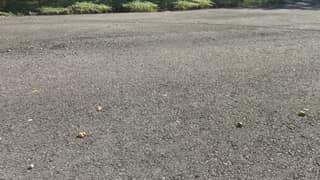
Our contractor confirmed that preparation was included.
We would want that translated into an actual scope: cleaning the surface, identifying contamination, addressing vegetation, and dealing with areas that need repair.
SealMaster's preparation guidance calls for thorough cleaning, treatment of oil spots, repair of damaged pavement, and filling suitable cracks before sealcoating.
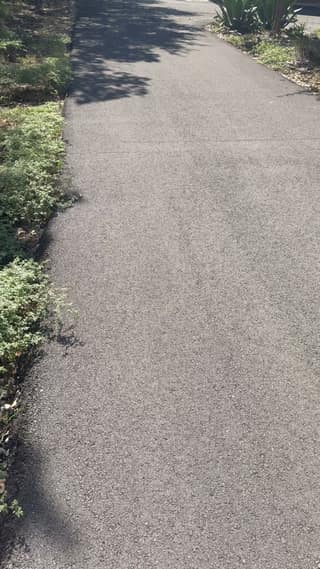
For us, "prep included" is a good start. Knowing what preparation will actually happen is better.
Crack filling before sealcoating
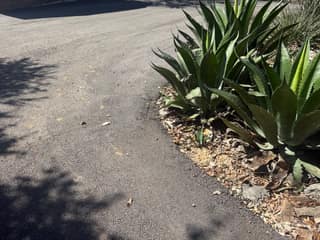
Our contractor also said he would fill cracks beforehand at no additional charge.
We appreciated that being included rather than discovering a separate charge on application day.
However, his message did not identify the crack-filling product. We would ask whether he planned to use a hot-applied or cold-applied material and how it would be prepared for coating.
Crack filling is a separate repair step. Simply applying driveway sealer over a crack is not the same process as cleaning and treating it with a suitable filler.
We would also clarify the limits of "any cracks." An isolated crack and a badly broken section of pavement are not interchangeable repair jobs.
Brooming next to the concrete
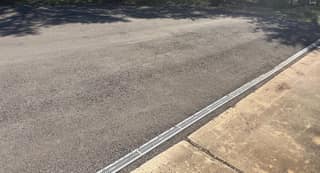
Our driveway has transitions where asphalt meets concrete.
The contractor said he would broom those areas to avoid overspray, then spray the remaining asphalt using a heavy-flow tip.
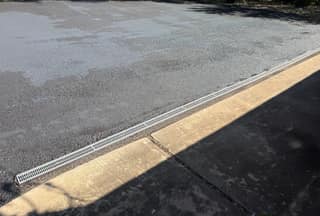
We liked that he had a specific plan for protecting the concrete rather than treating the whole area the same way.
Brush, spray, and squeegee methods can all be appropriate for compatible sealcoating products. The method needs to suit the material and its instructions; spraying is not automatically inferior simply because it is faster.
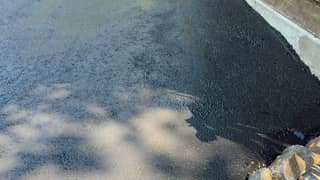
Cleanup afterward
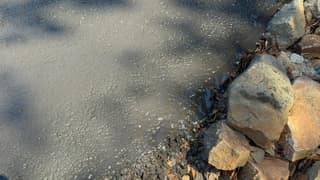
Cleanup was included in the price.
Before hiring anyone, we would clarify who is responsible for protecting concrete, garage doors, nearby walls, landscaping, and other surfaces—and for cleaning up accidental coating outside the agreed area.
We want the driveway maintained, not another cleanup project handed back to us.
Best Weather for Sealing a Driveway in Texas
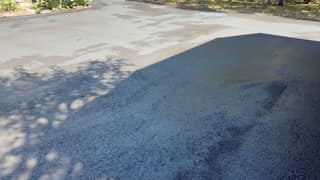
We would choose the weather window before choosing the date.
For Jennite AE, Neyra specifies air and pavement temperatures above 50°F, good drying conditions above that temperature for the following eight hours, and no temperatures below 50°F anticipated for 48 hours. Wet coating must be protected from rain.
That means a warm afternoon alone is not enough.
Ask the contractor to consider the overnight forecast, shade, humidity, and the actual pavement conditions. Neyra notes that cooler temperatures, high humidity, shade, and limited air movement can delay curing.
We wouldn't insist on a specific month for every Texas driveway. We would insist on a suitable application and drying window.
And we would be comfortable rescheduling. A convenient appointment isn't worth applying a product outside its requirements.
How Long After Sealing Can You Drive on the Driveway?
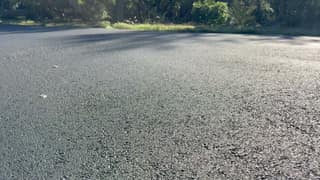
For planning, we would arrange alternate parking for at least 24–48 hours and leave room for a longer closure.
That is a planning allowance—not a promise that every application will be ready at the same time.
Neyra's NJ-S2 specification recommends at least 24 hours of good drying conditions after the final coat, with the surface checked before it is opened to traffic.
The important phrase is good drying conditions.
We would ask for written instructions covering when it is safe to walk, drive, and park, rather than assuming a surface that looks dry is ready for everything.
Before the appointment, our own checklist would be simple: move the vehicles, arrange another route to the house, notify anyone making deliveries, and keep the driveway blocked until the contractor clears it.
What about tire marks afterward?
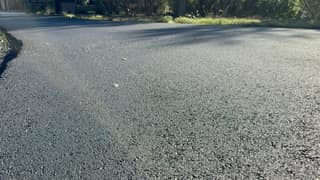
Light steering scuffs can occur on recently sealed surfaces, particularly in hot or humid conditions. Latex-ite advises keeping the vehicle moving while turning the wheels rather than steering in place.
That does not mean every problem should be dismissed as normal.
If coating is lifting, peeling, flaking, or transferring heavily, we would photograph it and contact the contractor before attempting a repair ourselves.
How Often Should You Reseal an Asphalt Driveway?
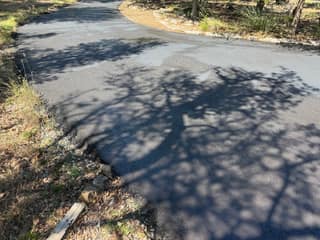
We would not automatically seal it every year.
The Colorado Asphalt Pavement Association gives a general maintenance interval of two to five years. That is a starting point, not a guarantee for every driveway or product.
Our approach would be to inspect the surface and ask whether another application is actually needed.
A driveway does not need to stay freshly painted-black forever to justify the original work. We would want the contractor to explain the condition, wear, and recommended maintenance—not just tell us another year has passed.
What does that mean for a maintenance budget?
Using our $2,000 price as a hypothetical future cost:
| Hypothetical resealing interval | Annualized cost |
|---|---|
| Every two years | $1,000 per year |
| Every three years | About $667 per year |
| Every five years | $400 per year |
Those are budgeting examples. They are not predictions of our coating's life or future contractor prices.
We would rather include a realistic maintenance allowance in our asphalt decision than pretend the initial paving bill was the only expense.
Asphalt Driveway Sealing: Pros and Cons
What we like
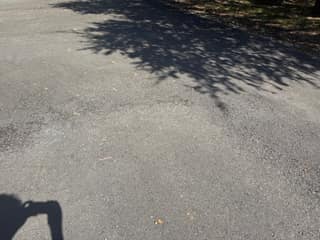
Surface maintenance. A properly specified coating can help protect sound asphalt from weathering. That was the practical reason we considered it, not just appearance.
A more uniform finish. The darker appearance is a benefit, although we would not confuse that cosmetic improvement with new pavement.
A chance to address small issues. Having preparation and crack filling included gave us a defined maintenance project rather than just a coating application.
What we would not overlook
It is a recurring expense. Our $2,000 cost belongs in the ownership budget.
The driveway has to be closed. We would plan parking and deliveries around the application.
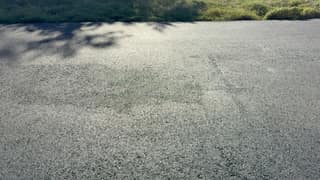
The result depends on more than the product name. Coat count, preparation, weather, and application details all need to be specified.
It will not rescue a failing driveway. Structural damage and drainage problems need their own solutions.
For us, sealcoating made sense as maintenance. It would make much less sense as an attempt to hide a problem that should be repaired.
Questions to Ask Your Sealcoating Contractor
These are the questions we would bring to the next quote.
| Ask this | What we want clarified |
|---|---|
| What exact product are you using? | Manufacturer, full product name, and current instructions—not just "commercial grade." |
| How many coats are included? | Separate coats, required drying between them, and the basis for any departure from manufacturer guidance. |
| What is the application rate and mix? | How much material is planned and which approved mixture is being used. |
| What does preparation include? | Cleaning, vegetation, oil spots, and identification of damaged areas. |
| What crack repairs are included? | Filler type, preparation, extent of repairs, and any exclusions. |
| How will you protect nearby surfaces? | Concrete, walls, doors, landscaping, and responsibility for accidental overspray. |
| What would cause you to reschedule? | Rain, temperature, and other unsuitable conditions. |
| When can we use the driveway again? | Written instructions for walking, driving, parking, and deliveries. |
| What is the complete price? | Area, minimum charges, extras, cleanup, and any additional fees or taxes. |
| What exactly does the warranty cover? | Duration, exclusions, who performs corrective work, and what remedy is included. |
We would also ask for insurance information and examples of older completed jobs—not just photographs taken immediately after sealing.
What Our Contractor's Warranty Covered
Our contractor said he would warranty application issues such as peeling or flaking.
That was useful, but we would still want the details in writing.
His message did not specify the duration, exclusions, or how a covered issue would be corrected. We would not describe it as a one-year, two-year, or lifetime warranty without that information.
Our follow-up would be:
"How long does the application warranty last, and what will you do if a covered problem occurs?"
We would also ask whether any separate manufacturer coverage applies. We would not assume that a contractor's promise automatically includes a manufacturer-backed installation warranty.
Our Final Verdict: Maintain the Driveway, but Get the Application Details Right
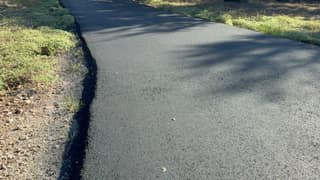
We waited one year before sealing our asphalt driveway. The price from the same contractor who paved it was $2,000 for approximately 6,000 square feet, including preparation, crack filling, and cleanup.
That brought our original paving and first sealing expense to $22,000.
We still feel good about the decision to choose asphalt over the $65,000 concrete quote or $120,000 paver quote. Maintenance was always something we needed to consider—not a reason to pretend those initial price differences didn't matter.
But our biggest takeaway from the sealing process is this:
Don't stop at the price or the product name. Get the application plan in writing.
We liked knowing which product was specified, that cracks would be addressed, how the concrete transitions would be protected, and that the contractor offered coverage for application problems.
The point we would clarify is the one-heavy-coat approach versus the manufacturer's published two-coat specification.
We would maintain the driveway again. Next time, we would make sure the coat count, coverage, drying requirements, and warranty are just as clearly defined as the total price.
Frequently asked questions
Is sealing an asphalt driveway worth it?
We think it is worth considering for a sound driveway that is ready for the treatment. We would not buy it solely because someone says our driveway should be blacker. We would want a clear maintenance purpose, a suitable product, complete preparation, and an application that follows its specifications.
Is $2,000 expensive for sealing 6,000 square feet?
It works out to approximately 33 cents per square foot. That falls within the commercial comparison range discussed in the article, but it doesn't settle whether a particular proposal is a good value. Our price included preparation, crack filling, cleanup, and the contractor's specified one-heavy-coat application. We would compare that scope with other quotes before deciding.
Does sealcoating fill cracks or fix potholes?
Not as a substitute for proper repairs. Crack filling and patching are separate steps. Extensive interconnected cracking, depressions, and other failed areas may require more substantial work before a coating makes sense.
Should the driveway be pressure-washed first?
It should be properly cleaned, but we wouldn't make pressure washing the only measure of preparation. We would ask how the contractor will remove the contamination actually present. Neyra's specification calls for different cleaning methods for loose debris, mud, and oil-affected areas.
Is adding water to sealer a sign of a bad contractor?
Not automatically. Jennite AE's technical information includes mixing with water and mineral aggregate. The question is whether the contractor is using an approved formula, not whether any water is present at all. We would ask for the intended mixture rather than guessing from the appearance of the spray.
How many gallons of sealer does a driveway need?
Use the exact product's coverage rate. Jennite AE's published reference is one gallon of concentrate per 90 square feet per coat. At that rate, 6,000 square feet represents about 67 gallons of concentrate per coat, before the specified mixing ingredients. That is not a measurement of what our contractor used, and a gallon of concentrate is not interchangeable with a gallon of every ready-to-use retail sealer.
What happens if it rains after sealing?
Wet Jennite AE needs protection from rain. If rain arrives before the coating is ready, we would keep traffic off it and have the contractor inspect the application before deciding what to do next. We would not assume it is ruined, or fine, without an assessment.
Can you apply this sealer to concrete or chip seal?
Not as a general-purpose coating. Neyra advises against Jennite AE on chip seals, gilsonite-containing sealers, and Portland cement concrete. The contractor should identify the existing surface and any previous treatment before selecting a product.
Does two-coat sealcoating cost twice as much?
We would not calculate it that way. Ask for a complete two-coat price. The contractor needs to account for materials, preparation, mobilization, drying, and labor; the price should come from the actual proposal, not an automatic multiplier.
Can you seal a driveway yourself?
For a smaller driveway, we would consider it after reading the selected product's instructions and pricing the entire job. For approximately 6,000 square feet, we preferred getting a professional price. A meaningful DIY comparison would include the correct quantity of sealer, crack-repair materials, cleaning supplies, application tools, protective equipment, and our time, not just the price of one bucket.


