


On this page
Where to buy
Read the full reviews

The Clear UV and current Dolphin Nautilus CC Plus both plug in, climb in-ground pool walls, and connect to an app. The price difference says more than that shared outline.


On October 1, 2026, Clear priced the UV at $1,999. Maytronics had the CC Plus on sale for $749, down from $849. The sale-price gap was $1,250.
For most pools, I would buy the CC Plus. It covers the floor and walls, weighs almost seven pounds less, and leaves enough money for years of brushes, filters, and manual waterline care.
The Clear UV makes sense when waterline cleaning is a frequent job, a three-year warranty matters, and the owner can handle a 27.6-pound robot. Its high published flow, fine filter rating, and built-in UV-C lamp come from Clear's specifications. Those figures need more care than repeating “more than twice the flow” and calling the decision finished.
I used the Clear UV nearly every day for three months in my in-ground pool. The photographed blue-and-black Nautilus came from a separate green-pool cleanup and is an older cartridge-filter version. I did not run equal side-by-side cycles or use that unit to test Wi-Fi features on current model 99996409-PCI.
Current Models at a Glance
| Detail | Clear UV | Current U.S. Nautilus CC Plus w/Wi-Fi |
|---|---|---|
| Model | Clear UV | 99996409-PCI |
| Official pool classification | In-ground | In-ground |
| Maximum pool length | 50 feet | 40 feet |
| Cleaning coverage | Floor, walls, and waterline | Floor and walls |
| Cleaning cycles | 1-, 2-, and 3-hour modes, plus custom modes | 2 hours |
| Brushes | Two active brushes | Two combination brushes; structured spec says no active brush |
| Manufacturer-listed flow | 8,500+ GPH | 4,500 GPH |
| Filter description | Top-access UltraBin; 1/180-micron panels claimed | Top-access Ultra-Fine Filter Kit |
| UV-C lamp | Yes; controlled in Clear app | No |
| App | Clear app | MyDolphin Plus |
| Cable | 59 feet with swivel | Swivel listed; length varies by documentation |
| Dry robot weight | 27.6 pounds | 20.8 pounds |
| Warranty | 3-year limited warranty | 1 year |
| Direct price on October 1, 2026 | $1,999, reduced from $2,999 | $749 sale; $849 regular price |
These are two manufacturers' published numbers. Test methods are not shown on the product pages, so cross-brand flow and filtration claims should be treated as specifications, not an independent shootout.
Waterline Coverage Is the Upgrade You Can See
Maytronics rates the current CC Plus for floor and wall cleaning. It can climb to the surface, but its specification marks waterline scrubbing as unavailable.

The photo shows the body reaching the top. It does not turn the robot into a waterline cleaner. A machine has to remain near the surface and move along the horizontal band to work that ring.
Clear rates the UV for floor, wall, and waterline coverage. In my pool, it climbed the wall and traveled along the tile line:

That was useful where pollen and body oils collected. The Clear app also has a waterline-only mode, so I could target the upper band without running a full cycle.
It still missed shallow stairs and my sun shelf on some cycles. Waterline coverage does not mean every horizontal ledge or tight corner gets cleaned. I kept a brush for those spots.
This is the first purchase test. If the waterline needs manual attention only once or twice a month, $1,250 buys an expensive shortcut. If a long tile band shows a ring every few days, the Clear removes a recurring job that the CC Plus is not designed to do.
Both Current Models Use a Top-Loading Basket
The Clear UV has one top-loading UltraBin. I lift it by the handle, open it, and rinse the four filter panels.

The basket held leaves, acorns, pine needles, and fine dirt in my pool. Pleated media takes more rinsing than open mesh because powder settles between the folds, but carrying one bin to the hose is simple.
Clear rates its dual-precision panels at 1 micron and 180 microns and recommends replacing them every three to six months, depending on conditions. I saw fine silt in the filters and less powder returning to the floor. I did not independently measure the pore size, so the micron values remain manufacturer specifications.
The older Nautilus I handled had two top-access cartridge assemblies:
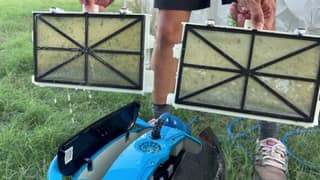
They retained fine material but required more work around clips, frames, and panel edges. That maintenance comparison applies to the unit shown, not every box sold under the CC Plus name.
Current Wi-Fi SKU 99996409-PCI uses a single top-loading Ultra-Fine basket. Maytronics says it lifts out and opens at the bottom for rinsing. That is closer to the Clear's one-bin routine than the photographed cartridges are, but I did not clean the current Nautilus basket and will not claim which one is quicker at the hose.
Flow Rate Is Not a Cleaning Score
Clear publishes 8,500-plus GPH for the UV, delivered by two pump motors. Maytronics lists 4,500 GPH for the current CC Plus.
The large difference helps explain why the Clear moved a lot of water through dense filter media and maintained wall contact in my pool. It does not prove that the Clear removes 89 percent more dirt or covers a pool nearly twice as well. The brands do not publish a shared test method, and pickup also depends on brush contact, navigation, debris size, filter loading, and pool shape.
Use the flow number as a design specification. Use the waterline rating, filter access, weight, cycle modes, and warranty as buying features you can compare directly.
Do Not Buy the Clear UV as a Chlorine Replacement
The built-in UV-C lamp is the feature named on the box. Clear says water passing through the robot is exposed to the lamp, which is controlled in the app. The company rates the replaceable lamp assembly for about 2,000 operating hours, typically two to three years depending on use.
The source material for this comparison does not include an independent test of UV dose, contact time, microbial reduction, or whole-pool turnover. I cannot translate the lamp into a promised chlorine reduction or claim that it prevents an algae bloom.
A moving pool robot also treats only the water that passes its lamp during a cycle. The pool still needs sanitizer, circulation, brushing, testing, and the main filter. My green-pool cleanup guide explains why physical debris removal and water chemistry are separate jobs.
I treat UV-C as a supplemental feature, not the reason to spend $1,250 more. Clear sells the Clear S with the same stated cleaning hardware but no UV lamp for $250 less. That price difference gives the UV feature its own test: if you would not pay $250 for the lamp and eventual replacement part, do not let it justify the larger jump from the CC Plus.
The Nautilus Is Easier to Lift
The Clear UV weighs 27.6 pounds without its cable. The current CC Plus weighs 20.8 pounds.
Seven pounds is easy to feel when the robot is below the coping. Bring either cleaner to the wall with its cable, take the handle, and pause at the surface while water drains. Never carry the machine by the floating cord.
I can manage the Clear, but it demands two hands and stable footing. The CC Plus is not a light 14-pound robot, yet it is the easier machine to retrieve and carry. Anyone with shoulder, back, or grip limitations should treat the Clear's weight as a disqualifier, not a detail to solve after delivery.
Both current models list an anti-tangle swivel. Cable management is similar on paper, although I did not use the current CC Plus swivel.
Both Have Apps, but the Clear Gives More Control
MyDolphin Plus gives the current CC Plus remote starts, status, and weekly scheduling. For a two-hour floor-and-wall cleaner, that covers the controls most owners use.
The Clear app adds six cleaning choices: one-hour Fast, two-hour Regular, three-hour Ultra, Floor only, Waterline only, and Custom. It also provides manual steering, live water temperature, scheduling, and the UV lamp control. Basic start, mode, and pickup functions remain on the power supply.
I used scheduling and the normal full-pool mode far more than manual steering. The extra controls are useful when a specific area needs work, but they do not erase missed steps or a packed filter.
Connected features can also change with app updates, phone support, and cloud service. I would choose based on coverage and hardware first. A power button still needs to start the robot if the app is unavailable.
The Warranty Difference Is Large but Not Worth $1,250 Alone
Clear lists a three-year limited warranty covering manufacturing defects on the robot, control box, cable, and UV module. Brushes and filter cartridges are wear items.
Maytronics lists one year for current U.S. CC Plus w/Wi-Fi model 99996409-PCI. Older, non-Wi-Fi, and regional CC Plus versions have carried different terms.
Two extra years of coverage are useful on submerged equipment. They do not predict three times the service life, and they do not repay a $1,250 purchase gap by themselves. A warranty only covers its stated defects and exclusions.
Save the model number, serial number, authorized-seller record, and invoice for either robot. Read the return policy separately; a 30-day trial is not the same as a three-year repair warranty.
Check the Nautilus Box, Not Just the Name
Maytronics has sold several cleaners as Nautilus CC Plus. Current U.S. model 99996409-PCI is listed for in-ground pools up to 40 feet with Wi-Fi, a swivel, an Ultra-Fine Filter Kit, and a one-year warranty.
The older unit in these photos supports only the physical observations I made about that robot. Its blue-and-black shell and cartridge doors do not verify a new seller's filter kit, app, power supply, swivel, or warranty.
Before buying, match all of these on the product page and invoice:
- model number;
- pool classification and maximum length;
- filter kit;
- Wi-Fi support;
- cable swivel;
- manufacturer warranty; and
- return terms.
If a retailer's headline and specification table disagree, get the answer in writing or buy elsewhere.
Who Should Buy Each Robot?
Buy the current Nautilus CC Plus w/Wi-Fi if:
- the in-ground pool is 40 feet or shorter;
- floor and wall cleaning cover the main job;
- manual waterline brushing is acceptable;
- low lifting weight matters relative to the Clear; and
- the budget is under $1,000.
Buy the Clear UV if:
- the in-ground pool is no longer than 50 feet;
- waterline cleaning is needed several times a week;
- a top-loading basket and targeted cleaning modes will be used;
- a three-year limited warranty is a requirement; and
- lifting a 27.6-pound dry robot is realistic.
Treat 8,500-plus GPH, 1-micron filtration, and UV-C performance as manufacturer claims, not independent proof that the pool needs fewer chemicals or will be cleaned twice as well.
My price threshold is a $1,000 gap. If the Clear UV is $1,000 or less above the CC Plus and recurring waterline work plus the longer warranty matter, I can justify the upgrade. At the $1,250 sale-price gap I found, I would buy the CC Plus for a typical 40-foot-or-shorter pool. I would spend $1,999 on the Clear only for a pool where waterline cleaning is a weekly burden and its extra weight is acceptable. If the UV lamp is not part of that decision, compare the less expensive Clear S before paying for the UV model.
More comparisons with these products
- Clear UV vs. Dolphin Cayman: Is the Waterline Worth $870? Clear UV and Dolphin Cayman compared on waterline cleaning, filters, lifting weight, scheduling, UV claims, warranty, and the current $870 price gap.
- Clear UV vs. Dolphin Escape: Start With the Pool A practical Clear UV and Dolphin Escape comparison covering pool compatibility, coverage, filters, lifting weight, controls, warranty, and ownership cost.
- Clear UV vs. Dolphin Premier: The Filter Decides It An owner comparison of the Clear UV and Dolphin Premier covering filters, leaves, waterline cleaning, controls, upkeep, warranty, and current price.
- Dolphin Cayman vs. Nautilus CC Plus: The Price Gap Matters Dolphin Cayman vs Nautilus CC Plus compared by model number, cleaning coverage, filters, weight, controls, warranty, and current price.
- Dolphin Escape vs. Nautilus CC Plus: Floor-Only or Wall-Climbing? Dolphin Escape vs Nautilus CC Plus compared on floor and wall coverage, pool size, filters, lifting weight, Wi-Fi, warranty, and price.
- Dolphin Premier vs. Nautilus CC Plus: Is the Upgrade Worth It? Dolphin Premier vs Nautilus CC Plus compared on waterline coverage, debris handling, controls, warranty, long-term use, and current price.
All comparisons Best Robotic Pool Cleaners All robotic pool cleaners
Frequently asked questions
Does the Dolphin Nautilus CC Plus scrub the waterline like the Clear UV?
No. Maytronics rates the Nautilus CC Plus for floors and walls only. It climbs to the top of the wall and falls back down; it does not travel sideways along the tile line. The Clear UV is engineered to stay at the surface and scrub the waterline.
Why is the Clear UV more than double the price of the Nautilus CC Plus?
Clear's $1,999 price buys rated waterline cleaning, a top-loading UltraBin, six modes, a built-in UV-C lamp, and a three-year limited warranty. Its 8,500-plus GPH and filter ratings are manufacturer claims. The current U.S. CC Plus lists at $849 before temporary discounts and has a one-year warranty.
Do both cleaners have smartphone apps?
Yes. The current U.S. Nautilus CC Plus w/ Wi-Fi (model 99996409-PCI) connects to MyDolphin Plus for remote starts and weekly scheduling. The Clear UV app adds schedules, manual steering, cleaning modes, UV control, and water temperature.
Which cleaner is easier to rinse and maintain?
The Clear UV I used has one top-loading UltraBin. The older Nautilus in the photos has two cartridge assemblies and took longer to rinse. Current Wi-Fi model 99996409-PCI also uses a single top-loading basket, but I did not clean that current basket, so I cannot compare the two rinse routines from experience.
How do the warranties compare?
Clear lists a three-year limited warranty. Maytronics lists a one-year warranty for the current U.S. Nautilus CC Plus w/ Wi-Fi model.


