


The verdict · Theragun Mini 2nd Gen
The Theragun Mini 2nd Gen remains a good compact massage gun for reachable areas such as the thighs. It weighs about a pound, offers three speeds, charges through USB-C, and can pair with the Therabody app. It is also discontinued, its rated 120-minute battery may have aged, and U.S. warranty coverage was short. Buy a complete, healthy used unit around $100 or less. Above roughly $130, a new Hypervolt Go 2 or a discounted Theragun Relief is easier to justify; near $220, choose the current Mini.
What works
- About one pound and compact enough for a small bag
- Rounded triangular housing sits securely in one hand
- Three physical speed settings work without opening an app
- USB-C charging avoids a proprietary power connector
- Bluetooth pairing is available for optional app controls
What doesn't
- Short body cannot reach the middle of the back easily
- No screen, pressure meter, or third-generation travel lock
- Used battery condition matters more than the original 120-minute rating
- U.S. warranty was one year for the device and 90 days for the battery and accessories
- Discontinued model competes with newer devices near the same price
Theragun Mini 2nd Gen — key specs
| Model | Theragun Mini, 2nd generation |
|---|---|
| Dimensions | 141 × 125 × 49 mm |
| Weight | 0.45 kg, about 1 pound |
| Amplitude | 12 mm |
| Speeds | 1,750, 2,100, and 2,400 percussions per minute |
| Battery rating | Up to 120 minutes; not independently measured here |
| Charging | USB-C port; original cable was USB-A to USB-C |
| Connectivity | Bluetooth pairing with the Therabody app |
| Attachments | Reviewed with Standard Ball; original and regional bundles vary |
| U.S. warranty when sold | 1 year for device; 90 days for battery, charger, and attachments |
| Current price context | Discontinued; U.S. certified-refurbished page showed $139 and sold out |
On this page
The Theragun Mini 2nd Gen makes the most sense as a used purchase now, not as old stock near its original retail price. Its one-pound body fits one hand, the button gives direct access to three speeds, and USB-C charging is easier to manage than another proprietary adapter. Those are still useful traits.


The buying decision has changed because Therabody replaced it. The current Mini is lighter, carries a longer battery rating, adds a travel lock, and comes with three attachments on the U.S. product page. Meanwhile, the second generation is old enough that battery condition and missing parts can matter more than a clean housing.
My hands-on scope is narrow and clear. I used the photographed second-generation Mini for targeted massage on a leg. I can describe the grip, controls, reach, port, and Standard Ball attachment. I did not run a timed battery test or collect evidence for medical, pain, or athletic-performance outcomes.
How to tell this is the second generation
The second-generation Mini has a rounded triangular housing rather than the first generation's larger, sharper triangular form. Therabody lists the body at 141 by 125 by 49 mm and 0.45 kg, just under one pound.
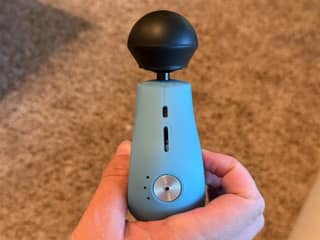
The controls and ports provide a better ID than color:
- one round power and speed button on the side;
- three small white speed LEDs;
- a separate battery-status light;
- a USB-C charging port;
- a short fixed percussion arm with a removable head;
- Bluetooth support described in the second-generation manual.
The label and dimensions are the final check. Third-generation marketing photos can look similar at a glance, but that model is listed at 0.40 kg, has a travel lock, and ships in the U.S. with a newer three-head set.
The grip works best on areas directly in front of you
The body sits in the palm rather than hanging below a straight pistol grip. With the Standard Ball against a thigh, my wrist could stay close to neutral and my fingers wrapped around the upper edge without reaching for a trigger.
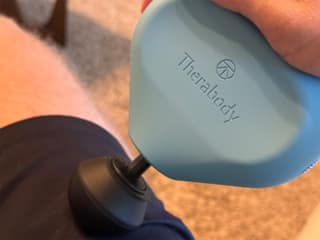
That compact shape is the reason to own this version. It takes little room in a gym bag, suitcase, or desk drawer, and the soft case keeps the attachment from pressing against loose items.
The same dimensions create the main ergonomic limit. A short body gives very little extra reach. Quads, outer thighs, calves, forearms, and the front of the shoulders are accessible. The area between the shoulder blades is not. A full-size Theragun with a long triangular handle lets the user change grip positions and reach farther around the torso.
Grip comfort is also personal. The housing is broad compared with a cylindrical handle. Smaller hands may need to pinch the top edge rather than fully wrap it, and vibration still travels through the body into the holding hand.
Three speeds cover the useful range
Therabody specifies 1,750, 2,100, and 2,400 percussions per minute. A long press turns the device on or off; a short press moves through the settings. One, two, or three white lights indicate the selected speed.
There is no screen and no pressure meter. The user has to judge contact force, so the sensible starting point is the lowest speed with light pressure. Pushing hard enough to slow or stall the arm is not a useful measure of quality.
Therabody documentation lists 12 mm of amplitude for this generation. Amplitude describes the distance traveled by the attachment, not a guaranteed effect on the body. Speed changes how often the head strikes; it does not turn the device into a medical treatment.
The physical controls are enough for normal operation. The second-generation manual also documents Bluetooth pairing with the Therabody app, where the app can adjust speed and present guided presets. I would treat that as optional. A discontinued product should remain useful even if phone support changes later.
Attachment count depends on the package, not just the generation
The photographed Mini has the Standard Ball, a medium-firm round head suited to broad contact on a thigh. Its shape spreads pressure across more area than a narrow point.
Therabody's records do not support a blanket claim that every second-generation Mini came with only one attachment. The generation's manual describes three: Standard Ball, Dampener, and Thumb. Therabody's European second-generation product page also lists all three. The current U.S. certified-refurbished page lists the device with Standard Ball only, plus a cable and soft case.
The records point to a package or regional difference, not a separate motor generation. For a used listing, ask the seller to photograph everything included. A bare device and Standard Ball may be complete for one U.S. refurbished bundle but incomplete compared with a three-head retail package.
Extra heads change contact shape and firmness. They do not change the three speeds or 12 mm travel. If you want the Dampener and Thumb, price those pieces before deciding that a one-head Mini is cheap.
USB-C is convenient; an old battery is the larger concern
The original package used a USB-A-to-USB-C cable. USB-C on the device is useful because replacement cables are common. Follow Therabody's charging instructions and use a compatible power source.
Therabody rates the battery at around 120 minutes. I did not run the Mini from a full charge to shutdown, so that number stays a manufacturer maximum here. Speed, applied pressure, temperature, and cell age can all change runtime.
Age matters because the battery is internal. A private-party unit may look nearly new while holding much less charge than it did when sold. Before buying locally:
- Confirm that it accepts a charge without the connector cutting in and out.
- Check the battery-status colors and all three speed lights.
- Run every speed and listen for scraping, rattling, or an uneven pitch.
- Apply light pressure and make sure the arm keeps a steady rhythm.
- Check that the attachment seats firmly and pulls off without a cracked connector.
- Let it run long enough to reveal an immediate battery drop or heat problem.
A five-minute check cannot establish 120-minute capacity. It can expose a unit that is already failing.
For storage, switch it off before removing the head and keep liquid away from the housing and charging port. Therabody says the Mini is not waterproof. Wipe residue from the device and attachment rather than rinsing or soaking either one.
The U.S. warranty was short and may be gone on a used unit
Therabody's published U.S. terms for the Mini 2nd Gen provided:
- one year for the device;
- 90 days for the battery;
- 90 days for the charger and attachments.
Coverage began with a qualifying purchase from Therabody or an authorized retail partner. The same terms exclude ordinary aging and do not extend standard coverage to opened, used, repaired, repackaged, or resealed products. A private-party buyer should assume there is no useful factory warranty unless Therabody confirms otherwise in writing.
That 90-day battery term is a weak point because the internal battery is the part most likely to change with age. Proof of purchase still has value for a newer old-stock unit, but the calendar matters more than the seller's claim that it was rarely used.
Price decides if the second generation still makes sense
Therabody's U.S. certified-refurbished page showed the second-generation Mini at $139, reduced from $189.99, and sold out on October 1, 2026. The current third-generation Mini was $219.99.
For a private sale, I would use these limits:
- $75 to $100: fair for a clean unit with stable charging, healthy short-run behavior, Standard Ball, and case.
- $100 to $130: consider it only if battery behavior is convincing and the bundle includes the three original heads or other useful extras.
- Above $130: skip it unless a documented manufacturer-refurbished warranty changes the risk.
- Near $190: old stock is poor value next to current models.
These are buying thresholds, not estimates of remaining battery capacity. A sealed old box can still contain cells that have aged in storage.
Three alternatives set a low ceiling on used prices
The Theragun Mini 3rd Gen is the direct replacement. Therabody lists it at 0.40 kg, three speeds, up to 150 minutes, USB-C, Bluetooth, a travel lock, and three attachments. Its $219.99 official price is much higher than a $100 used Mini 2, but only $30 above the older model's former $189.99 price. New old stock therefore needs a large markdown.
The Hypervolt Go 2 cost $139 on Hyperice's U.S. site on October 1, 2026. It is heavier at 1.5 pounds and has a pistol-style handle, but it includes flat and bullet heads and carries a three-hour manufacturer battery rating. At the same price as an out-of-warranty Mini 2, the new Hypervolt is the better value unless the Theragun's smaller body is the priority.
The Theragun Relief lists at $159.99. Therabody's charcoal U.S. package includes Standard Ball, Dampener, and Thumb attachments, with a 1.37-pound body and 120-minute rating. It takes more bag space, but its longer triangular handle reaches more of the back. Choose it when reach matters more than the Mini's one-pound weight.
Use it as a massage device, not a diagnosis
This review does not treat a change in sensation as proof of faster healing, better performance, or an injury being safe to train through. The photo shows targeted leg massage. It cannot show a medical result.
Therabody's precautions and contraindications call for care or professional guidance around recent injury or surgery, bony areas, altered sensation, sensitivity to pressure, varicose veins, and medications that change sensation. The company advises seeking medical guidance before use with open wounds, bruising, fractures, deep vein thrombosis, bleeding disorders, uncontrolled hypertension, and several other conditions.
Do not apply the device directly to the face, head, throat, neck, or genitalia. Start at low speed over soft tissue, use light pressure, keep the head moving, and stop if it causes pain, numbness, or unusual symptoms.
If the purchase is tied to running, keep the training decision separate from the device. Our heart-rate variability guide explains why a readiness number needs context, while the Zone 2 running guide deals with workload and pacing. A few minutes with a massage gun does not cancel a warning sign from the body.
Who should buy this older Mini
Buy the second generation if portability is the main requirement, the areas you want to reach are mostly legs and arms, and a verified unit costs around $100 or less. It also fits buyers who prefer a physical button but still want optional Bluetooth routines.
Skip it if you need to reach the center of your back, want several heads without chasing missing accessories, or want fresh warranty coverage. Skip any used unit with intermittent charging, a loose attachment connector, unstable motor sound, or a seller who will not let it run.
My recommendation
At $100 in good condition, the Mini 2 is small enough and straightforward enough to earn a place in a gym or travel bag. I would pay a little more only for a three-attachment bundle with clear proof of condition.
At $130 or higher, I would buy a new alternative or save for the third-generation Mini. The second generation's size remains appealing; its age, short battery warranty, and uncertain bundle make the discount non-negotiable.
Frequently asked questions
Which Theragun Mini generation is shown here?
This is the second-generation Mini. It matches Therabody's 141 × 125 × 49 mm dimensions, 0.45 kg weight, side power button, three speed LEDs, and USB-C charging layout. It is not the larger first generation or the lighter third generation.
Does the Theragun Mini 2nd Gen have Bluetooth?
Yes. The second-generation manual describes Bluetooth pairing with the Therabody app for guided presets, speed adjustment, and usage recommendations. The three speeds also work from the physical button, so an app is optional.
How long does the second-generation Mini battery last?
Therabody rates it for around 120 minutes. This review did not include a timed battery rundown. Runtime changes with pressure, speed, temperature, and battery age, so a used device may run for less than the original rating.
How many attachments came with the Theragun Mini 2nd Gen?
The original second-generation manual and Therabody's European listing show Standard Ball, Dampener, and Thumb attachments. Therabody's current U.S. certified-refurbished listing shows only Standard Ball. The photographed unit has Standard Ball, so confirm the exact bundle instead of using generation alone.
Can the Theragun Mini be used on an injury?
Do not use a massage gun to diagnose or treat an injury. Therabody advises medical guidance around recent injury or surgery, fractures, bruising, open wounds, altered sensation, clotting risks, and other listed conditions. Stop if use causes pain, numbness, or unusual symptoms.


