


The verdict · Ondilo ICO
The ICO is the easiest way I've found to watch my pool water. It sends hourly pH, ORP, and temperature readings to my phone and tells me how much chemical to add for my pool volume. A February charge still had 23% left in mid-July. I still have to calibrate the probes and use a drop kit for a full chemistry panel.
What works
- Puts hourly pH, ORP, and temperature readings in the phone app
- Connects straight to my home Wi-Fi with no hub, dongle, or subscription
- Tells me how much chemical to add based on my pool volume and the products I entered
- A February battery charge still had 23% remaining in mid-July
- I can replace the plug-and-play probes without throwing away the monitor
- Warned me about drifting pH days before I would've seen a change in the water
What doesn't
- It gives me ORP (disinfection power), not chlorine in ppm
- I have to calibrate the probes, and I'll eventually need to replace them
Ondilo ICO — key specs
| Measurements | pH, ORP/Redox (disinfection), and water temperature every hour; TDS on the salt version |
|---|---|
| Ideal ranges | pH 7.2–7.6; ORP 650–750 mV; TDS 3,000–5,000 ppm (salt pools) |
| Connectivity | Wi-Fi 802.11 b/g/n (2.4 GHz) and Bluetooth Low Energy; no hub required |
| Battery | Rechargeable lithium-ion over USB; my February charge had 23% left in mid-July |
| Build | UV- and chemical-resistant ABS, IP68 waterproof, rigid probe shell |
| Probes | Plug-and-play, removable, and replaceable; comes with a calibration kit |
| App | iOS and Android, free, no subscription; trends by day/week/month |
| Smart home | Home Assistant support |
On this page
Most of my pool cleaning already runs on a schedule. A Clear UV robot handles the floor and walls, a skimmer clears the surface, and my old Dolphin Premier showed me how much work automation could save. Water testing was still a weekly chore: dip a strip, hold it against a color chart in direct sun, and decide which shade of pink looked closest.
The Ondilo ICO took over that job. It floats in my pool, checks the water every hour, and sends the numbers to my phone. After more than a year, it handles my daily checks, and I only pull out the drop kit for the rest of the chemistry panel.
What the ICO Measures
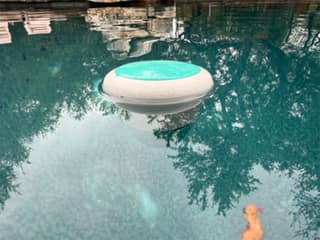
The ICO looks like an oversized chlorine floater, with the sensors below the surface. Removable plug-and-play probes inside the white lower cone check three things every hour:
- pH: This shows the water's acidity and alkalinity balance. The app wants it in the standard 7.2–7.6 range.
- ORP (Redox): This tells me the water's current disinfecting power in millivolts. The ideal range is roughly 650–750 mV.
- Water temperature: Warmer water consumes sanitizer faster and supports quicker algae growth.
The saltwater version adds a TDS (salinity) probe and targets 3,000–5,000 ppm. My pool uses chlorine, so I used the standard two-probe model.
The ABS body resists pool chemicals and UV and has an IP68 waterproof rating. It connects straight to 2.4 GHz home Wi-Fi, with Bluetooth available near the pool, so I didn't need a base station or dongle. The iOS and Android app is free, with no subscription fee.
Setup and Calibration
Setup took me about 20 minutes, mostly because the probes needed to be prepared. The app walked me through Bluetooth pairing, Wi-Fi, and a pool profile. I entered my pool's volume and type, whether it used chlorine or salt, and the treatment products I keep on hand. The app uses those details to tell me how much to dose.
The probes arrive dry, so they need conditioning and calibration before they go in the pool. The included kit has reference solutions; I dipped each probe as directed and waited for the app to confirm it. My pH probe started out a couple of tenths high, and calibration brought it in line with my Taylor drop kit.
For the first few months, I kept checking the ICO against my Taylor kit. Once calibrated, its pH stayed within about 0.1 of my manual tests. That's a smaller difference than I could make out on a test strip.
Living With Hourly Data
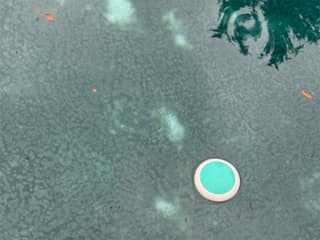
A weekly test gives me one reading out of seven days of changing water. By the time the next strip shows a problem, the chemistry may have been drifting for days.
The ICO logs a reading every hour and graphs it by day, week, or month. After more than a year, I could see what rain, heat, and a busy swimming weekend did to my pool:
- Rain: A large summer storm lowered my pH and ORP within hours. The app flagged the change before the water looked different.
- Heat: When the water reached the 90s during a Texas July, the ORP declined day after day as the pool used more chlorine.
- Heavy use: A weekend with six children in the pool produced a clear drop in disinfection power. I dosed that evening instead of finding cloudy water several days later.
The app turns those readings into plain instructions. It uses the pool volume and treatment products I entered to tell me how much to add, then reminds me to check again. It also brings in the weather forecast when a change is likely. I don't calculate the doses myself anymore.
Why It Reports ORP Instead of Chlorine PPM
The ICO doesn't give me a chlorine reading in ppm.
Instead, it reads ORP, or oxidation-reduction potential. ORP tells me how well the water can disinfect at that moment while factoring in pH, stabilizer, and temperature. Commercial pools are regulated using ORP for that reason. A strip can show 2 ppm of chlorine even when the wrong pH makes it less effective; the ORP number catches that loss of disinfecting power.
The millivolt scale took some getting used to after years of thinking in ppm. For the first month, I used my regular test kit alongside the ICO and watched how the two readings moved in my pool. That gave me a baseline for a healthy ORP range and made the millivolt number more useful to me than a chlorine reading alone.
Battery, Build, and Connectivity
Ondilo says the battery needs a charge once or twice a season. In more than a year, I charged mine once, topping it up in February. By mid-July, after months of hourly readings, it still showed 23%. I use the USB charger so rarely that it hasn't turned into another pool chore.
The housing still looked new after more than a year in direct sun and chlorine, including an occasional bump from my Clear UV. A rigid shell guards the probes below the water. Since the sensors pull out, I can replace an aging probe without throwing away the whole monitor.
For more than a year, my ICO has sent its readings over 2.4 GHz home Wi-Fi without a hub or separate dongle. It floats low, so the network still has to reach the pool. If your pool sits at the edge of Wi-Fi coverage, you may need a mesh node near the back of the house to get readings on time. It also works with Home Assistant.
What It Won't Do
- No alkalinity, calcium hardness, or CYA readings: I still pull out the drop kit for these slower-changing numbers a few times each season. The ICO handles the daily checks, not the full panel.
- No automatic dosing: The app tells me what to add, but I pour in each treatment myself. I prefer that to leaving a machine to pump acid when nobody's watching.
- Visible in the pool: The small monitor floats on the surface. During parties, I can tuck it into the skimmer basket.
Verdict After More Than a Year
The ICO turned a weekly chore I had to remember into an hourly check I don't have to think about. Now my phone tells me when the chemistry needs attention instead of making me guess from a strip.
One midweek alert caught a falling pH days before the problem would've been visible or expensive. Catching changes that early can head off late algae treatment, cloudy water, and lost swimming time.
If you enjoy using a Taylor kit twice a week, the ICO may feel like a luxury. I still need that kit for alkalinity, calcium hardness, and CYA, but I don't depend on test strips for daily pH and sanitation checks anymore. I'd recommend the ICO once you've automated the cleaning and want more chemistry data between manual tests.


