


The verdict · Samsung StormWash DW80R5061US
The StormWash cleaned three years of daily loads without a repair, leak, or error code. Its concentrated jets handle baked-on pans, and the 48 dBA wash cycle fades into the background. A Bosch 800 dries plastics better and has smoother racks, but mine cost roughly twice as much.
What works
- StormWash jets remove baked-on food from pans
- 48 dBA cycles are easy to miss from the next room
- AutoRelease door gets dishes and glassware drier
- Three racks and 15-place-setting capacity handle family loads
- Three years with no repairs, leaks, or error codes
What doesn't
- Plastic containers and lids still come out damp
- Normal cycles take 2.5 to 3 hours
- Loaded racks clatter more than those in premium machines
Samsung StormWash DW80R5061US — key specs
| Model | Samsung DW80R5061US |
|---|---|
| Type | 24-inch built-in, top control, fingerprint-resistant stainless |
| Noise | 48 dBA |
| Capacity | 15 place settings, 3 racks, adjustable middle rack |
| Cycles | Auto, Normal, Heavy, Delicate, Express 60, Rinse Only |
| Options | StormWash, Hi-Temp, Sanitize, Lower Rack, Delay Start |
| Drying | Heated dry and AutoRelease door |
| Efficiency | ENERGY STAR certified, stainless tub |
| Typical price | $550–$700, frequently on sale near $500 |
On this page
The Samsung StormWash DW80R5061US ran nearly every day for three years in my previous house. It never broke or leaked, and I never had to wash an entire load again by hand. For a dishwasher in the $500–$700 range, that record matters more to me than a long feature list.


I bought a Bosch 800 Series after moving, and I prefer it. The Bosch is quieter, dries plastic containers more thoroughly, and has much smoother racks. It also cost roughly twice as much. After living with both, I know what the StormWash gives up to hit its lower price.
Three Years in Our Kitchen
The StormWash was our household dishwasher. This 48 dBA, top-control model handled family dinners, holiday cooking, party cleanup, and baked-on casserole dishes I should have soaked first. We ran it almost every day for three years.
What It Looks and Feels Like
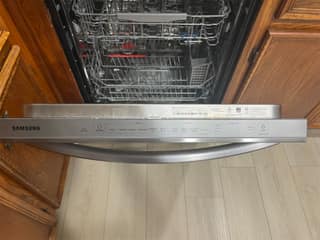
The StormWash is a standard 24-inch built-in with a fingerprint-resistant stainless front. Its controls sit along the upper edge of the door, leaving only the steel panel and curved bar handle visible when the dishwasher is closed. The simple design blended into my kitchen, and the finish resisted most marks despite daily contact with kids' hands.
The door feels sturdy, and the stainless tub showed no rust, warping, or yellowing after three years of heat, steam, and detergent. Previous budget dishwashers made me expect more rattles at this price, but the Samsung never developed any.
I used the two headline features all the time: the StormWash jets for problem pans and the AutoRelease door for drier dishes.
How Well It Cleans
In the back corner of the tub, rotating StormWash jets blast one part of the load with extra water. That's where I put the lasagna pan, crusted skillet, or mixing bowl coated in dried pancake batter before selecting StormWash. Those difficult pieces came out clean instead of going through another wash.
The Normal cycle took care of typical daily loads. Glasses stayed free of spots when I kept the rinse aid filled, silverware came out clean, and plates didn't need a second pass. I can count the failures from three years on one hand, and each happened when a sheet pan blocked a spray arm.
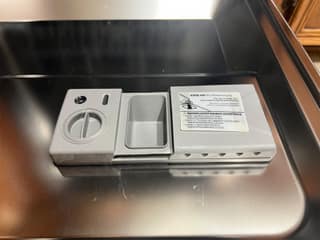
Keep the rinse aid full: Nothing made a bigger difference to drying and water spots. The reservoir lasts about a month, and the indicator window shows when it's time for a refill. I learned to check it after ignoring it too often during the first year.
The Cycles and Buttons I Used
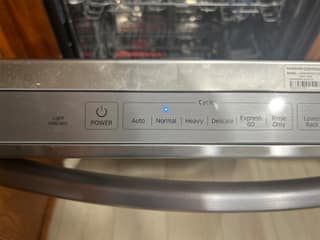
I never needed more than the six cycles: Auto, Normal, Heavy, Delicate, Express 60, and Rinse Only. Most days I chose Normal. Baked-on food got Heavy with StormWash, and Express 60 handled lightly soiled dishes when guests were due within an hour. It doesn't dry as thoroughly, but it got those quick loads done.
For baby bottles and cutting boards, there are Hi-Temp Wash and Sanitize. Lower Rack sends the wash toward a partial load of pots below, and Delay Start lets the machine run overnight when electricity is cheaper.
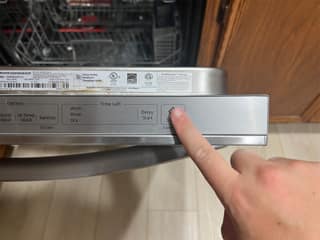
Every control is a labeled physical button. Starting a load takes four steps: press Power, select a cycle, press Start, and close the door. There is no touchscreen, app, or Wi-Fi setup. I review plenty of smart-home gear, but I don't need it on a dishwasher.
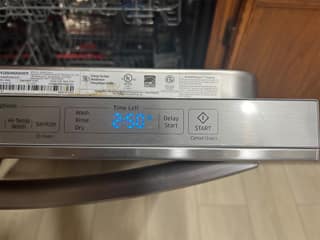
The blue LED display shows the time left, and separate lights mark the Wash, Rinse, and Dry stages. The 2:50 in the photo is typical: a Normal cycle usually took between two and a half and three hours. That can feel slow if you're replacing an older dishwasher, though the low noise kept the long runtime from bothering me.
Racks and Loading
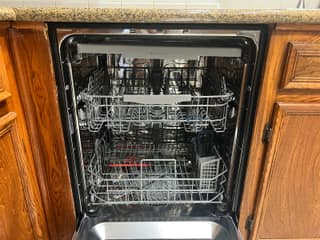
Samsung says the three racks hold 15 place settings, which was enough for our family's loads. The shallow third rack keeps spatulas, cooking utensils, and lids flat. Moving those long pieces out of the silverware basket also frees space in the lower rack.
The middle rack moves up or down to fit tall stemware above or stock pots below. Fold-down tines open a flat section in the lower rack for sheet pans and mixing bowls. The layout worked well, but the lower price shows in the rack movement. Fully loaded, the bottom rack rolled out with more clatter than the one in my Bosch.
Drying and the AutoRelease Door
About 10–15 minutes before a cycle finishes, the AutoRelease door opens a few inches so steam can escape and fresh air can circulate. The unexpected movement startled me the first time. After that, I appreciated finding dry dishes, glasses, and ceramics at the end of a load.
Plastic was still the weak point. Water collected in the recesses of food-storage lids and kids' cups because plastic doesn't hold heat like ceramic or glass. AutoRelease cut down the moisture but didn't get rid of it. Most dishwashers around this price have the same problem. I still spent a few seconds wiping plastic pieces before putting them away.
It's Quiet, and Mine Never Broke
At 48 dBA, the StormWash was quiet enough that I opened it mid-cycle more than once because I didn't realize it was running. I couldn't hear it from the next room. That's handy when the kitchen opens into a living area.
In three years of near-daily use, it never needed a service call and never leaked or threw an error code. The only maintenance was rinsing the self-cleaning filter every couple of months.
What My Bosch Does Better
After moving, I replaced the Samsung with a Bosch 800 Series. The Bosch is so quiet that I check the light it projects on the floor to confirm it's running. Its racks move like well-fitted drawer slides, and CrystalDry gets my plastic containers dry.
After using the Bosch, the StormWash's damp plastics and rougher rack glide are harder to ignore. But the Samsung still gave me clean dishes for all three years I owned it. The Bosch cost about twice as much, and the StormWash does most of the daily job for roughly half the price.
My Take After Three Years
At $500–$700, I'd recommend the StormWash if you're fine wiping a few plastic lids and waiting two and a half to three hours for a Normal cycle. Mine made it through three years of near-daily loads without a repair.
The Bosch 800 Series is better if your budget allows for it; that's what I chose for my new house. At the lower price, the StormWash never failed at the job that mattered: cleaning the dishes.
Where to Buy
Home Depot, Lowe's, Best Buy, and Amazon carry the StormWash line. Sales around Memorial Day, July 4th, and Black Friday can cut $100–$150 from the price. I wouldn't pay full MSRP.
If you're also shopping for coffee gear, I compare five models in my guide to the best home espresso machines.


